Category Archives: The Church

Enlarging Our Circles

“I have become all things to all people so that by all possible means I might save some.”

(1 Corinthians 9:22)

My great friend, former college roommate, and “brother from another mother” is one of those people who can walk into a room of strangers and have three new “best friends” within an hour.  I have seen him do this time and time again, and it always amazes me.  I saw him do it at school.  I’ve seen him do this in supermarkets, restaurants, and in crowds of people…all kinds of people: every size, shape, background and hue.  He has a way of being forward with people without being offensive to them; and they like him.  He reminds me of Paul in some ways; he never stops being himself, but he quickly finds common ground with others.

Image result for common ground

At first glance, Paul’s comment opens him to the criticism of being a spiritual chameleon, someone who changes his colors and stripes in order to fit-in with those in his immediate surroundings.  I think the truth, however, is far from that shallow assessment.  The gospel and the sharing of it was, he believed, far too important for him to be parochial.  That was the fault of the Pharisees, his former identity and association, whose narrow-mindedness prevented them from seeing GOD at work in their midst.

Paul never lost or hid his core identity, but he did modify his evangelistic approach according to the needs of those he was trying to reach.  Quoting Swiss theologian Frederic Godet, Donald Metz wrote, “No observance appeared to [Paul] too irksome, no requirement too stupid, no prejudice too absurd, to prevent his dealing tenderly with it in his view of saving souls.”* The ex-Pharisee Paul, who initially preferred a very small circle, became the Apostle Paul with a greatly enlarged circle (and was always interested in enlarging even that as GOD gave him opportunity).

Image result for relational

Christianity is essentially a relational way of life (see Matthew 22:35-40) modeled perfectly by Jesus.  Being open to enlarging our circles and seizing opportunities to do so is in harmony with having an identity in Christ.  Insistence on maintaining small circles is not in harmony with who Jesus is and who believers are called to be.  Small circle mindedness is more suited to the Pharisees who had a very limited view as to who was or could be worthy before GOD.  Much of what we see and hear these days speaks to me about preferring small, closely contained circles.

For Paul, a Jew steeped in the Hebrew Scriptures and the history of the “chosen” people, there was no shame in relating to someone weak in their understanding of spiritual things.  There was no shame for him in building a connection with the very culturally different Scythians and the proud, and sometimes arrogant Greeks.  He was as comfortable in the presence of slaves as he was with the free.  And despite the controversies over the last two millennia, his trust in and reliance on a number of women adds weight to his doctrinal statement that, in Christ, there is no difference between female and male.

Image result for chosen by god

Paul was making (and continues to make through his GOD-inspired letters) the point that it is the will of GOD that all people become chosen people.  Isn’t that the real purpose and message of the gospel?  Willingly enlarging our circles to include modern versions of the culturally and socially different is an affirmation of our intent to not be parochial and small-minded with this wonderful gift, the path to abundant and eternal life GOD has given us in Christ.  It says, “Everyone I work with or go to school with, everyone I meet, everyone I see but do not know, is my neighbor and I want them to be chosen; and I am open to connecting with them.  Who knows; I just may win some.”

* Metz, Donald.  “The First Epistle of Paul to the Corinthians,” Beacon Bible Commentary, Vol. 8, Kansas City: Beacon Hill Press, 1968, p. 402.

© Byron L. Hannon, 2019.  All rights reserved to text content unless otherwise noted.

When Will It Ever Stop?

“There is a river whose streams make glad the city of God,
the holy place where the Most High dwells.
God is within her, she will not fall.”  
(Psalm 46:4-5a)

Image result for heaven's river

A friend posted a comment and question on Facebook the other day, seemingly out of frustration with the recent violence and terrorism in our nation that has resulted in bloodshed and loss of lives.  Her question was, “When will it ever stop?”  It’s a question I’ve pondered off and on for so many years; and quite frankly, don’t see it happening any time soon.

My question is: What if it doesn’t stop?  What if it never gets really better in a way I think she means e.g. peoples’ lives, property and aspirations are uniformly valued, there is an absence in the broader society of an us vs. them mentality, and concerns and differences are addressed civilly and in an environment of mutual respect.  To what extent has this ever been the case anywhere in the world on a sustained basis?  Aside from Antarctica, I don’t think there’s a continent on the Earth that can make that claim.  I believe even a cursory study of history bears this out.

Image result for antarctica

We live (and have lived) in a world in which people and nations operate according to a paradigm of scarcity.  In this paradigm, there are not enough resources for everyone, and there isn’t enough freedom for everyone.  A few have to be on top; they have rights that are enforced, and they get the bulk of the privileges.  This means that some have to be on the bottom; they have few rights (that are routinely and systematically enforced), and have even fewer privileges.  Then there are the remainders who are somewhere in the middle, often aspiring to get closer to the top, and so grateful they aren’t on the bottom (as far as they can tell).  There’s a reason someone came up with the phrase, “It sucks to be you!which is how a lot of people in the middle feel and treat those on the bottom.  Those on the top may not give those in the middle or on the bottom much attention at all unless they do things that become irritating, like complaining about justice, economic inequity, and equal protection under the law, to name a few.

Sometimes those who perceive the presence of inequity are really voicing fear of a loss of privilege and favor e.g. “there isn’t enough to go around for all of us; and you’re not getting mine (or ours).”  Belief in this kind of scarcity produces tension that, from time-to-time in history, has erupted into physical violence.  There can also be the psychological violence that is added on by those who are dismissive and who refuse to consider root causes, particularly if it is not in their interest to do so.  This is not new stuff.   It’s been a reality in virtually every human society.

Image result for who's a cynic                          

I don’t consider myself a cynic or a fatalist.  I don’t think everyone’s sole motive in life is self-interest.  I just think most people are nice people whose social engagement has a limited range.  Beyond the social issues that hit their personal radars as being important or where they believe they have influence which they should exercise, they are generally disengaged.  For instance, how many adults in an entire local community might have concerns about their local public school system?  Measure that against the number of people from that same community who regularly attend school board meetings.  I’m neither seeking to discourage others nor to profit or otherwise gain advantage from the circumstances I describe.  That would be cynical!  And I do have hope for the future…but as a follower of Christ rather than as an optimist in a humanistic sense.

It would be nice if we could, finally, meaningfully address these issues…but what if we don’t get there?  What if the answer to Rodney King’s question, “Can’t we all get along?” is too enigmatic for us to be able to respond affirmatively with certainty.  What then?  The history of humanity isn’t all that encouraging, despite those modernists who continue to insist that education, and particularly science and technology, is the key to a brighter future for all.  For all of the strengths with this path (and there are many), there are still too many exceptions in the way that smart has been used that prevent this from being a reliable rule on which to place the weight of one’s faith.

Thinking about these issues brought me back to Psalm 46, something I’ve read and meditated on often.  Aside from its immediate context concerning the ultimate security of Jerusalem, it more broadly reminds us that those who are in GOD’s hands have no reason to fear, regardless of how the externals appear.  The psalmist uses powerful, dramatic imagery to make the point:

God is our refuge and strength,
an ever-present help in trouble.
 Therefore we will not fear, though the earth give way
and the mountains fall into the heart of the sea,
 though its waters roar and foam
and the mountains quake with their surging…

The Lord Almighty is with us;
the God of Jacob is our fortress. (vv. 1-3; 7)

 When will it ever stop?  I believe it will one day…possibly in this world, but most certainly in the next.  And when it does, it will bring with it a new paradigm, one of abundance for all who abide.  Then no one will denied because of fear or greed or for any other reason.


© Byron L. Hannon, 2019.  All rights reserved to original text content.

When Identity Clashes With Evidence

“Now faith is the substance of things hoped for, the evidence of things not seen.”      (Hebrews 11:1)

Some time ago, I published a piece which made a case for leaving room in the Church for those who valued their tribal, language and/or national identity.  This call for space was, in part, an acknowledgement that these markers reflect our respective cultural comfort levels, and are valid from a Christian perspective to the extent they do not presume superiority of one to another.  Despite differences in tongue, historical culture, or church emphasis, there remains “one Lord, one faith, one baptism” (Ephesians 4:5).  These identity markers must be subservient to Christ if identity is to be Christian.

Image result for reading silhouette

Last night (I am drafting this on a Monday afternoon) I was working my way through a book review I regularly read, and came across a statement in a review of a book which analyzes contemporary identity politics (I’ve paraphrased the comment to make it a little more readable): Identity attachment accepts arguments only from an authority closely tied to that particular identity, because evidence is always subordinate to identity.1

The author means, by “identity attachment” the way some folks assign a psychologically pleasing definition or set of characteristics to themselves and others in whatever particular group they are jointly members of.  The “evidence” the author references are the facts which may contradict the preferred definitions of a group.  An easy example might be a view that says: men don’t have a need to express their emotions.  Men who like  being perceived as stoically unemotional can easily buy-in to this view, despite ample evidence that the emotions of men run just as deeply as those of women, but are often expressed differently.  Different expression is not the same as no expression.  Sadly, gender self-bias may just scratch the surface of the ways “identity attachment” is manifest in the circles in which most of us travel.

Image result for groupthink

 Buy-in to unsupportable views of self is encouraged by persistent fellowship with those who think similarly.  The result is group-think identity that ignores the facts because the facts inconveniently undermine the preferred way we want to think of ourselves, particularly when someone we regard as an authority figure encourages us to do just that.  Another way to state the author’s point is that some people choose to ignore truth because they prefer the distortions promoted by another person, persons and/or institution.  This, according to the book’s author, is the basis for the kind of reactions in attitudes and behaviors that advance divisions among people.  There certainly appears to be sufficient support for this in the world’s socio-political environment, both in empirical evidence (i.e. sensed and observed) and by data-driven evidence.

Image result for divisions in the church

An important issue for me is the implication(s) for the effective functioning of the body of Christ if the identity attachments of its members are not rooted in and submissive to Christ.  Even now, I hear the voice of Paul in my head warning against divisions and factions in the Church (Romans 16:17; 1 Cor. 1:10; 3:3; 11:18-19), calling it carnal and therefore not worthy of Jesus Christ.  This is not to denounce identity attachment as being fundamentally non-Christian; we need not deny our humanity nor how that humanity is expressed outwardly.  I clearly have my culturally-based preferences, and gravitate to and enjoy them often.  It is, however, a denunciation of identity attachments when they, knowingly, contradict and attempt to subvert the will of GOD.  That is called sin.

There is a little-discussed branch of theology called “Theopolitical” which views theological beliefs through the lens of social and political structures and considers political beliefs that may be implied in Christian teachings.2  A commonly used example of this is the use of Paul’s teaching on submitting to leaders in government because they are placed in authority by GOD (Romans 13:1).  This argument is used by many Christians as an endorsement of their preferred political leader(s) as having GOD’s favor.

What is often missed (or ignored) is that while Paul’s teaching stresses the inherent goodness in a believer’s submission, he offers no explicit statement about inherent goodness (or lack thereof) in the authority to whom submission is to be given.  The focus of Paul’s teaching is on the believer who is to demonstrate faith in Christ by submission; the focus is not on the person in authority.  This is why Jesus was able to say, “So give back to Caesar what is Caesar’s, and to God what is God’s” (Matthew 22:17).  Perhaps it is also why men and women like Nebuchadnezzar, Jezebel, the Herods, Herodias and her daughter, Pontius Pilate, Nero, Caligula, Hitler, Stalin, Pol Pot, and the various despots and petty dictators currently in positions of political authority today were/are allowed by GOD to be in power.  The Christian response to these may be just one component of faith being tried over the long course of history (see Job 23:10).

                  Image result for job 23 10`

A danger of “theopolitical” thinking that encourages identity politics is that it can facilitate little difference between the attitudes (and sometimes behaviors) of those inside the Church from those outside the Church.  When this happens, those who are called to be the salty, peculiar people of GOD, actually better resemble those around them who are in need of saltiness and the peculiar influence of GOD’s holy presence.  This happens much easier when the goal of faith, and the way it is practiced daily, is about belonging to a group(s) whose socio-political worldview is under-girded by the local church, or in the least, not challenged by the local church.  The goal of Christian faith has always been union with GOD (see Jesus’ prayer in John 17), nothing else.

Settling for belonging to a community of faith with whom we identify without also wholly identifying with the holy Christ and being led by the Spirit of holiness is an immature and shallow faith that is easily dented and is less than the worthiness of His calling.  My first pastor called this “living beneath our privilege.”  Beyond that, it can lead to expressions of heresy.

Image result for golden calf

It is here that our other-than-in-Christ identity can, if we’re not careful, assume equal status with our proclaimed faith in GOD.  This is a violation of the 1st, 2nd, and 3rd commandments…to start with.  The parable of the Good Samaritan is an excellent illustration (Luke 10:30-37).  Both the priest and the Levite saw the seriously injured man, but took no pity on him.  Jesus seems to stress their position and status in the Jewish community, that is, their identity, to make His point.  They were VIPs, and we can assume that they were very well aware of it.  They either ascribed to themselves a superior view compared to this man or so negative a view of him that made his need insufficient to warrant their valuable time and attention.  We can also suppose that this man was a Jew because he was traveling from Jerusalem.  If he was a Jew, his outer clothing may have identified him as such, making the decision by the priest and Levite doubly damning.  The evidence of the teachings of GOD were subordinate to their identity as important people.  It fell to the despised Samaritan to demonstrate the royal law of love.  We can consider this as Jesus’ take on identity politics.

 In ascribing to our other-than-in-Christ identity positive traits aimed at supporting our superiority, we also seek to define those outside of our identity.  Our sense of superiority allows us to assume we can define others, and we do.  We find ways to minimize them in our eyes, and we may even attempt to project those views outwardly.  We assign to them traits that, when revealed, can range from subtle discounting all the way to pernicious hatred.  We seek to legitimize our views and attitudes with arguments that, though sometimes well-crafted and seemingly astute, ultimately reflect human wisdom that is at odds with the logos of GOD.  And we all have done it, and we have all experienced it.  We all have been group stereotyped, sometimes in multiple ways.  I’m thinking of at least four ways in which I’ve been subjected.

I believe this is the spirit of anti-Christ at work in people who we would otherwise say are good people.  It is that spirit because it subordinates the explicit expression of GOD’s will with views that ignore the commands of Christ in favor of those which support our preferred way of seeing ourselves and others.  This amounts to ignoring the evidence for faith in Christ Jesus, His teachings, His commands, and the redeeming, sanctifying work He accomplished at Calvary.  Anything that does this cannot be considered Christian.

I understand why this other-than-in-Christ approach to identity has so much appeal.  It feels empowering to those who feel disaffected and disenfranchised (somewhat like the Zealots of Jesus’ day).  With that, we must ask the question, ‘What is the origin and source of this powerful feeling?’  If it is not of GOD (and hopefully I’ve made the case that it is not of GOD), then it is to be disregarded and discarded, for Christ’s sake.

Identity politics which pits, whether with great subtlety or brazenly, tongue against tongue, tribe against tribe, nation against nation has no place in the Church of Jesus Christ.  Where it exists, may GOD root it out!  Where we may have been complicit, may the Holy Spirit convict us of it, lead us to godly repentance, and give us a hunger to be united in Christ.                                         

1. In a review of A Thousand Small Sanities by Adam Gopnik. Reviewed by David Frum in the NY Times Book Review, July 7, 2019.

2. Global Wesleyan Dictionary of Theology. “Theopolitical Theology” by Nathan Kerr, p.536.  Kansas City: Beacon Hill Press, 2013.

© Byron L. Hannon, 2019.  All rights reserved for text content unless otherwise noted.

Appreciating What We Have

There is neither Jew nor Gentile, neither slave nor free, nor is there male and female, for you are all one in Christ Jesus.” (Galatians 3:28)

 “For everything God created is good, and nothing is to be rejected if it is received with thanksgiving, because it is consecrated by the word of God and prayer.” (1Timothy 4:4-5)


Since starting this blog a year ago, I took on a part-time ministerial assignment: partnering with several pastors and churches whose primary language is other than English.  I’ve been involved in this ministry for close to 10 months, and it’s been very rewarding to say the least.  As I have gotten to better know these pastors and their congregations, my appreciation of their preferred language and cultures has been edifying in unexpected ways.

One of those ways is the ability to fully enter into the worship of GOD even when I know very little of what is being sung or said.  I attribute this ability to the Holy Spirit who is never confused or limited, and is able to lead us across boundaries that are, otherwise, impenetrable because of our human frailty or, perhaps, because of a lack of will.  I count this as new learning for me.

Image result for crossing cultures

Reflecting on my attempts to cross cultures has drawn me to another conclusion: sometimes we are more appreciative of the “new” than we are of what has been present and available to us all along.  This, I think, is common to most of us.  We certainly see it in our young children, but the dynamic is not limited to them.  It’s as if the newness of something opens our eyes with joy and appreciation in ways that the equally valuable, but previously present “thing” failed to do.    Here, I refer specifically to women who are 50%+ of the world’s population, and, more often than not, the primary doers of work and sustainers of ministry in the local church (there’s much objective data, both historical and contemporary, to support this last point).  Women have been a major part of the Church, working and often leading, from the beginning, and have been under-appreciated, stymied, and stunted, for my two cents.

Image result for women in the church

Our “appreciation and celebration” of diversity in the Church need not take on over-sized proportions if we allow ourselves to be molded by the Spirit and the Word.  When we fail in this molding, we often try to make-up for it by making “big deals” out of what should be an accepted reality: unity in the Church.  If the Church of Jesus Christ reflected more of a Trinitarian model of inter-relationships between its members rather than a spiritually outmoded and divisive model more reflective of the hierarchical, patriarchal, and dominant culture dynamics common under the Old Covenant, valuing some members over others, the separations of groups so common in the world would not be so common in the Church, as it still is today.  This model, so inconsistent with the New Covenant, is the Church’s version of the doctrine of separate but equal.1  The dynamics of separation create inequality, a fact underscored by Galatians 3:28.

I’m grateful for the teachers, mentors, and colleagues in the faith (of all hues and genders), who have and continue to influence my faith.  Each has blessed me.  I want to highlight one, Rev. Shirley Goodman whose recently published book, Riding In Cars with Men2, was an eye-opener.  I’ve been privileged to call her friend and to work with her for many years, and I highly recommend you consider reading what she has to say.  Who knows how it may impact you.

Riding in Cars with Men.jpg

  1. The doctrine of separate but equal was codified as the law of the land by the Supreme Court in 1896 through Plessy vs. Ferguson. In this case, the U.S. Supreme Court ruled that racially separate facilities, if equal, were not discriminatory, if they did not otherwise violate the constitution.  It was not overturned until 1954 when the Supreme Court heard and ruled on Brown vs. Board of Education.

  1. Riding In Cars with Men by Shirley Goodman (TheSheRev, LLC, © 2019) is available through Amazon in both paperback and electronic formats.


 © Byron L. Hannon, 2019.  All rights reserved to original text content unless otherwise noted.

Addendum: Is Compassion Justice?

I don’t ordinarily do this, but was moved to share this thought from noted theologian, Walter Brueggemann.  The language may be a little academic for some, but I think it’s well worth working through.  It is a reminder of how utterly different and unique the kingdom of GOD is when compared to the kingdoms of this world.

“Jesus in his solidarity with the marginal ones is moved to compassion.  Compassion constitutes a radical form of criticism, for it announces that the hurt is to be taken seriously, that the hurt is not to be accepted as normal and natural but is an abnormal and unacceptable condition for humanness.  In the arrangement of ‘lawfulness’  in Jesus’ time, as in the ancient empire of Pharaoh, the one unpermitted quality of relation was compassion.  Empires are never built or maintained on the basis of compassion.  The norms of law (social control) are never accommodated to persons, but persons are accommodated to the norms.  Otherwise the norms will collapse and with them the whole power arrangement.  Thus the compassion of Jesus is to be understood not simply as a personal emotional reaction but as a public criticism in which he dares to act upon his concern against the entire numbness of his social context.”

Quoted from A Guide to Prayer for Ministers And Other Servants, The Upper Room, Nashville, TN, 1983.

Is Compassion Justice?

“When He saw the crowds, He had compassion on them, because they were harassed and helpless, like sheep without a shepherd.” (Matthew 9:37)


Recently, I heard someone try to make a case that compassion is equivalent to justice.  I’ve been thinking about this ever since hearing this because justice (or a perceived lack of it) dominates many thoughts and conversations in the world.  Let’s take a minute to unpack this a little.

Image result for yellow jacket protest

The yellow-jacket protesters in France believe many of the economic and social policies of the French government are unjust. The Rohingya minority in Myanmar (formerly Burma) for years have made claims of brutal repression by the Myanmar government.  Both pro-Brexiteers and anti-Brexiteers in England are convinced their positions are the most just for their nation.  Venezuela seems on the brink of civil war, with a significant number (if not majority) seeking to oust the controlling communist-leaning government, which is largely seen as an unjust oppressor of all but its supporters.  Worldwide, ride share drivers have protested what they believe are unfair “labor” practices by the companies with whom they contract (the drivers are technically not employees but independent contractors).  Mass public teacher strikes in the US seem to happen more frequently than ever because of pay, benefits and a general belief that they are grossly under-appreciated and supported.  A Saudi royal and “friend” of our government may have been complicit in the brutal assassination of a journalist, without the penalty of serious repercussion, all because the journalist was critical of Saudi policies and of this royal member in particular.  Refugees and asylum-seekers around the world are opting out of their home nations thinking they can get a better deal for themselves and their families elsewhere …and the elsewhere countries are, ambivalent, if not outright hostile to receiving them.  Abortion and sexual orientation issues along with the #MeToo movement and Black Lives Matter nearly seem like last year’s news because of the prevalence of so many other things now being associated with social justice.  And the examples here are just a snapshot.

Image result for compassion

How does compassion, for the people who have legitimate complaints, amount to justice? A working definition of justice that fits well with concepts in the Hebrew Bible and the New Testament is to make things right.  The phrase “do justice” is common to Scripture; it is a verb phrase, an action or series of actions.  As I’ve thought about the original question, I realized that the disconnect I was experiencing about compassion equating to justice was because I conflated compassion with a feeling rather than an action.  I wonder how many of us never view compassion as anything other than a feeling of pity, tenderness and/or concern.

The compassion Jesus experienced went to the core of His being, and the result was action that impacted individual lives in a way that made things right for them. More so, He set in motion a movement, the very purpose of which was to challenge that which was not right in the world and to make or influence those very things to be made right.  That movement is called His Church.

“Tomorrow is always another day to make things right” – Lauryn Hill 

I think the Church is still in the business of making things right and influencing the growth and power of justice in the world; however, we can’t have success if the only kind of compassion we experience is limited to feeling bad and wishing things were different…and we don’t know how many more tomorrows we have.  I can’t credit anyone with these words because the speaker is unknown, but it is worth repeating, “Sympathy sees and says, ‘I am sorry.’  Compassion feels and whispers, ‘I will help.’”*

Thank you to the many who help, whose compassion results in justice-seeking by combining their faith with actions that bless, uplift, love, challenge and are willing to say, “That’s not right! There’s a right way, a good way, a godly way.”  The world needs that from the Church.

* Found in Deep Fire, a book of quotes compiled by Harold Vaughan, Christ Life Publications, Vinton, VA, 2013.

© Byron L. Hannon, 2019. All rights reserved to text content unless otherwise noted.

Still Up for a Surprise

“…You shall have a sacred assembly…” (Leviticus 23:7)


I have never been one who got excited about attending large meeting gatherings. I’m sure that’s directly related to my introverted temperament.  My feelings have always been the same, regardless of whether the events were connected to my previous secular employment or, in more recent years, the church.  But like so many things in life that don’t align with my personal preferences, I make whatever adjustments are needed to accommodate participation.  It comes with the territory.

Image result for church meetings

Later this week is our annual district assembly, a large gathering of pastors and lay delegates and district officials who, historically, come together for two days to review the past year, conduct business assigned exclusively to the collective group of delegates, and to cast vision for the future.  Interspersed throughout the two days are times for worship and proclamation of GOD’s Word.  The preaching is done by a leading elder in our denomination, who also presides over the whole shebang.  These assemblies take place across much of the world at different points on the calendar.

Many people love these occasions; it gives them a chance to hang-out with their delegation, eat multiple meals with friends at nearby restaurants, and catch-up with folks they haven’t seen for a time. It allows them to hear about other things happening on the district and to hear the heart of their own district leader.  Sometimes there is a sense of spectacle not normally found in a local church setting.  The whole thing is somewhat like theater except that those who attend are sometimes the actors and sometimes the audience.  In all honesty, none of this has ever caused me to want to attend…but I did (and do) because being a part came (and comes) with my ministerial role and responsibility.  And I need to say that I’m confident that I never attended with a scowl on my face like I know I did when my mother used to take me to the doctor many decades ago.

Image result for unhappy child clipart

So it’s somewhat of surprise that I’m looking forward to attending this year’s assembly later this week. The reason is that there will be a lot more emphasis on worshipping GOD and seeking GOD, together, and less emphasis on report sharing and other district business than in my memory.  It will look and feel more like a sacred assembly than a really big annual church meeting.  I’m looking forward to this and to being both an actor and a member of the audience.  Perhaps all of us, from the various corners of our geographically large district, different walks of life, diverse races, cultures and languages, and wide range of occupations and interests will hear from the One we all claim as Lord, celebrating Him, first of all, most of all.  May it be so.  May it be sacred.

Image result for sacred assembly

© Byron L. Hannon, 2019. All rights reserved to text content.


A Church Reality

After this I looked, and there before me was a great multitude that no one could count, from every nation, tribe, people and language, standing before the throne and before the Lamb. They were wearing white robes and were holding palm branches in their hands. And they cried out in a loud voice: “Salvation belongs to our God, who sits on the throne, and to the Lamb.” — Revelation 7:9-10, NIV

Note: While this post, like the others,  is consistent with the aims of my blog, some readers may find the content a little more weighty than usual.  Still, I hope you will read it thoughtfully, and hopefully discover something useful.   Blessings.


Image result for revelation 7 9-10

I like the picture that John paints. It reminds me that there is room for everyone wherever GOD is the center of worship.  That room does not require uniformity, in fact, external differences are highlighted, but in all of this there is unity.

I think we sometimes fall prey to the idea that unity requires uniformity, despite the fact that  GOD created all of this diversity.  We see this in the Earth’s flora and fauna, and we see it in humanity.  Even in the courts of heaven, as John the Apostle notes, tribal and related differences will be evident among those who will come out of the “great tribulation.”  Their unity will be in their collective worship of the High and Holy One and in their service to Him, not in any external sameness or difference. Continue reading

All Are Welcome

“And let them make Me a sanctuary, that I may dwell among them.” – Exodus 25:8

 Given my theological orientation, the doctrine of sanctification carries special weight with me. I believe GOD calls us all to a salvation experience through Jesus Christ (addresses the consequences of our sins), and then, in simple terms, He calls us beyond to a Holy Spirit-empowered and guided life in Jesus Christ marked by willing, loving, complete, obedient submission to His Lordship. I could say more, much more, but this post is not for the purpose of systematic theology. It is about one particular aspect of the Church.

In addition to having been a pastor in a local church, I have visited quite a few over the years, occasionally to preach, but more often to simply enter into a house of worship, enter into the fellowship of worship with other believers, and to hear and be challenged by the proclamation of the Word of GOD. Unless those visits were in churches where I was known, I didn’t volunteer anything about being a pastor or even that I was a Christian. If someone asked, I’d tell them, but I’m not otherwise interested in promoting any bona fides; I just wanted to hang out in church.

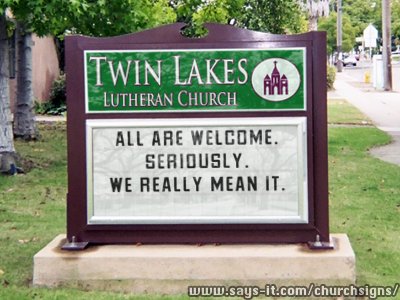
Image result for church sign all are welcome

Essential to each of these experiences was whether I was actively and intentionally welcomed, whether I felt welcomed.  I don’t have enough fingers or toes to count the church signs I’ve seen that said, “All Are Welcome.”  But the only way to really know is to go inside.  Most times when I have gone inside have been positive, but there have been a few times when that wasn’t the case.  Those particular buildings all had what many refer to as sanctuaries, but they weren’t sanctuary spaces for me.

Image result for word families

The words “sanctuary” and “sanctification” are more like siblings than first-cousins. They both concern that which has been set aside, exclusively, for holy use.  In the case of “sanctuary,” our normal usage refers to a holy or consecrated space for the purpose of worship or refuge.  A chorus I know, sings:

So forget about yourself and concentrate on Him,

And worship Him.

So forget about yourself and concentrate on Him,

And worship Him.

So forget about yourself and concentrate on Him,

And worship Him.

Worship Him, Christ the Lord.

 Can anyone forget about themselves when they don’t feel welcomed, when they don’t feel emotionally safe? That is what I and anyone/everyone should experience when we enter GOD’s sanctuary.  It should be a place where you and I have temporary refuge from the cares and weighty issues of life and experience peace because it is holy for that purpose.  Sure, I’m more likely to experience that when I enter into the sanctuary of my “home” church, but what about the person who has no church home?  What about the visitor (believer or unbeliever) who is searching for the presence of the Holy, whether they know it or not?  This is a legitimate spiritual need and calls local church leaders to a level of awareness and sensitivity beyond what works for them and the usual crowd associated with that particular church.

Image result for whole counsel of god

I want to be careful to not neglect what I believe to be another way to view this issue. I generally don’t prefer the King James Version of Scripture, but, in the case of the verse above, the phrasing suggests that GOD, Himself, wants to be our sanctuary.  The context of the immediately preceding verses points to the construction of a physical sanctuary as the intended understanding, and I respect that.  However, when viewed through the lens of all of Scripture, I think the idea of GOD desiring to be a sanctuary for His people is a settled issue.

Image result for make me a sanctuary

As an extended point, I believe that those made in the image of GOD, redeemed and reborn through the blood of the Lamb, should increasingly have the characteristics of sanctuary themselves. They are people who offer others temporary respite and refuge from the weights we all carry because they spend significant time in the presence of GOD, and His holiness is present in them.  They are sanctuaries on two feet, and the world needs them desperately.  If you’ve been around such people, you know what I’m saying.

People gravitate to where they feel safe, comfortable and cared for, and that includes where and with whom they worship and/or choose to be in relationship with. The converse is also true.  Church signs often say “All Are Welcome? Are all welcome or is that welcome conditional?  Local church greeters and each of us, individually, communicate both conditional and unconditional welcome.  Our smiles, extended hands, open hearts and genuine interest attract; our blank faces, frowns, grudgingly offered or withheld hands, and cursory interest don’t attract.

Image result for God has room 

GOD never has a “No Vacancy” sign in His Kingdom; we shouldn’t either.

© Byron L. Hannon, 2018. All rights reserved to text content.


When Christians Pick Sides

“I hear that when you come together as a church, there are divisions among you, and to some extent I believe it.  No doubt there have to be differences among you to show which of you have God’s approval.” – 1 Corinthians 11:18-19

I don’t think there are many things more discouraging to church leaders than to see  divisions in their church. I don’t mean simple differences of opinions.  Whenever you get more than one person in the same room, it’s guaranteed that a difference of opinion will surface, whether it’s something minor like favored sports team or even more significant like candidates for political office.  What I’m talking about are those divisions that result in a break in fellowship (or which reveal that biblical fellowship never existed).

Image result for church division quotes

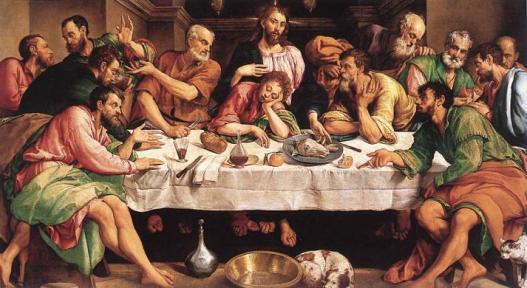
Whenever I think of the church in Corinth, awareness of their immaturity and carnality surfaces quickly. So much of what Paul wrote to them in his first letter dealt with the superficiality of their faith which too often revealed itself in unrighteous attitudes and behavior.  In the passage referenced above and in succeeding verses, he points to a serious deficit in their regard for each other, particularly toward poorer members of the church, when they came together for the Lord’s Supper, one of the times when the unity of the church should be a defining mark.

Image result for corinthian church communion

We know from reading the first chapter of this letter that one of the sources of division in the Corinthian church was based on which Christian “personality” (Paul, Apollos, Peter, Christ) church members aligned themselves to. I read all of this, and almost feel the disgust that Paul feels because he’s got to try to nip this junk in the bud to protect the infant church from itself as it struggles to grow in maturity and strength and to protect the integrity of the church’s testimony to an unbelieving world.

In the years since this letter to the Corinthian Christians, how far have we come? I think a long and good way in many, many ways.  But I’m also cognizant that “the thief comes only to steal and kill and destroy…” and one of the ways he does that is to get us to divide ourselves into factions that reveal the absence of fellowship and a lack of interest in being in fellowship.  Are there Christians with whom I cannot be in fellowship?  What about you?  Do they exist?  If the answer is “yes,” then maybe Paul is talking to us, too.

Image result for heresy

I find it telling that the same word used for “divisions” or “factions” is used for the word “heresy,” because when Christians take competing sides on issues that have little to do with GOD’s love, with GOD’s redemptive cares, with GOD’s word (our truth), with GOD’s will (our path), when we exchange any side for GOD’s side, this has the effect of distracting people and pulling them away from the faith which is, fundamentally, what heresy is.

Image result for church problems

Our humanity allows us to connect emotionally with other people, issues and other things with a capacity that is probably much deeper than we are aware. A stewardship responsibility comes with this wonderful ability.  We need GOD’s help in discerning the issues to which we align ourselves, particularly when they have the potential to separate us from others.  Not everything out there and available for us to sign-up to is from GOD nor necessarily pleasing to Him, and constitutes “junk” that needs to be nipped in the bud before it damages the church and its testimony.  John the Apostle says much the same thing when he says, “Dear friends, do not believe every spirit, but test the spirits to see whether they are from God, because many false prophets have gone out into the world” (1 John4:1).

Doing this will help us get on and stay on GOD’s side.

© Byron L. Hannon, 2018. All right reserved for text content.


© Byron L. Hannon, 2018. All right reserved for text content.