Author Archives: Byron Hannon

Unknown's avatar

About Byron Hannon

I am a discipler, teacher, coach (and ordained elder) passionate about helping people move beyond the “elementary teachings about Christ” (Hebrews 6:1) to maturity and the fullness of the abundant life promised by Jesus (John 10:10) in our postmodern, post-Christian, and post-truth world

A Personal, Personal Relationship

“…I am like a weaned child with its mother; like a weaned child I am content.”              – Psalm 131:2

 I have a problem with clichés…although I hesitantly admit that I do use them from time-to-time. The problem I have that is that they often reduce ideas, topics, and experiences down to a catchphrase that is, too often, so much more simplistic than the idea, topic or experience merits.  Saying to someone, for instance, that “GOD works all things to the good” when they are grieving a loss lacks sensitivity and is an untimely misuse of Romans 8:28.  Better to say nothing, and just offer presence.  What about this one: “Ignorance is bliss.” No, ignorance is dangerous.  I can think of other examples I’ve heard (and maybe even used), as I’m sure you can.

Image result for cliches

One that particularly grips me is when I hear someone say they have a “personal relationship with Jesus Christ” or when someone says to another that this “personal relationship “ is what they need. To be clear, I don’t quibble with the concept at all.  If I did, having this blog would be a gross contradiction.  My concern is what I perceive as the uninformed way I’ve heard that phrase bandied about.

CAN YOU SAY MORE ABOUT THAT?

On the occasions I’ve asked someone what having a personal relationship with Jesus Christ means to them, it’s been common to hear something along the lines of “It means that you’ve asked Jesus into your heart, asked Him to forgive your sins, you are made a new creation, and join the family of GOD.” I don’t want to be a jerk, so I try to frame my follow-up query, “Yes…and?” as graciously as I can.  It’s usually at this point that I get a few blank stares.  I want to know from them what else is going on that makes this important decision more than a transaction.  What, specifically, makes this a personal relationship?

Image result for i LIKE words

Like most writers I know, words are important to me; and words that relate to who we are in Christ and who we are called to be in Christ carry significant meaning. Jesus explained spiritual concepts in common, relatable language, including the heavy use of metaphors and similes, e.g. “The kingdom of heaven is like…” These are simple, clear ways to communicate the high value of the free gift of salvation in Jesus Christ.  These parables, however, are not simplistic because they don’t leave the hearer with an incomplete picture of the nature and extent of the offer.

Image result for mother and toddler painting

David’s simile (Psalm 131) paints a clear picture of the depths that personal relationship can go, in this instance the relationship between a mother and a toddler.  Apart from the abnormal circumstances which do exist for some people, unfortunately, most of us can relate to the depth of love and deep bond between a mother and child.  This is a relationship that lasts a lifetime, maturing as both mother and child grow older, but remaining the same at its core.  How many of you reading this have traits like your mother or father or both?  How many of you have been told, “The way you say that/do that reminds me of your mom/dad?”  Parental relationships run deep and leave an indelible, and very often, noticeable mark on each child.  Even as individuals, we are never so separated that we don’t remind others of those who birthed us.

David’s illustration is simple but it is not simplistic; it paints a vivid picture with varied colors of spiritual implication.  Yes, there were days when you/me/others made decisions that led to a spiritual transaction with GOD, but what else came with that?

I like David’s use of the mother/toddler picture because it puts my relationship with GOD in a much more realistic perspective. I need more than a covering for sin, and a position as a new creation.  I need to be the new creation that knows inherently that I am created for Him, that I am completely dependent on Him, and am happy to be with Him.  I want it to be deeply personal, not as a proposition but as a living reality.

Perhaps to eclipse the cliché, maybe I’ll start saying, “I have a personal, personal relationship with Jesus Christ,” just to be clear.

© Byron L. Hannon, 2018. All rights reserved for text content.

On Being

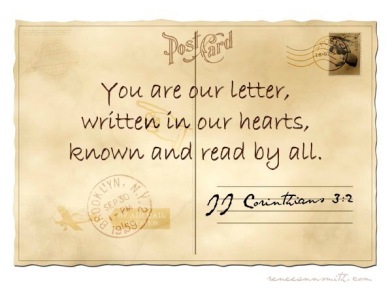
“You yourselves are our letter, written on our hearts, known and read by everyone.”             – 2 Cor. 3:2

 Like a lot of people who write, either as a vocation or avocation, much of my time is spent observing, processing, thinking/meditating and making conclusions. Occasionally, the fruit of that winds-up as a blog post. There are times, however, when I don’t want to do any of that; I just want to be.

Image result for introvert tired after socializing

After successive days of meeting with folks, either individually or in groups, with more to come and all for good reasons, and a snafu with some home improvements my wife and I just made, my introverted inner self is virtually screaming, “Enough! Leave me alone…at least for a while; I need to recharge.” I don’t want to think; I don’t want to evaluate and conclude; and I don’t want to expend any energy reducing things to 500 – 750 words for possible consumption by others. I just want to be. I’ve heard others say that from time-to-time, and asking “What does that mean?” seems fair.

The relationship between being and doing is a little tricky: what we are (being) determines the fruit we bear (doing), and conversely, the nature of what we consistently do influences what we are. Accepting the subjectivity of it all (because we each have our individual lenses, preferences, and inner wiring), I like Paul’s metaphor of being a “letter” available for anyone to read. Whether I speak or not, whether I write or not, I want to be someone “worthy of my calling,” not always seeking readers, but always available to be read.

Image result for 2 Corinthians 3:2

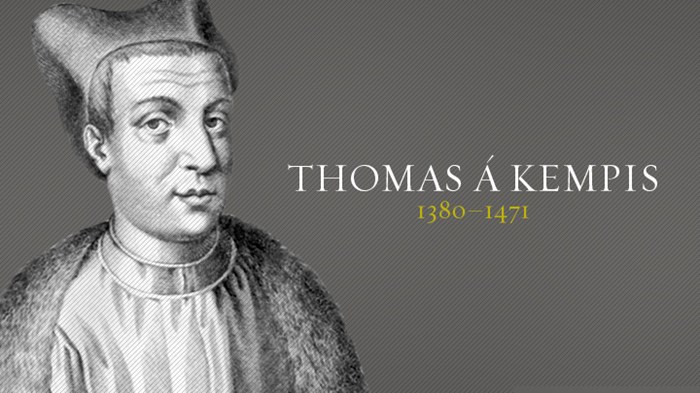
Still it begs the question, “What’s in my letter?” Centuries ago, Thomas à Kempis (a 15th century monk) wrote a series of devotional thoughts and exhortations that became the well-known book, Imitation of Christ©.  One of his prayers has resonated with me so much that I have it in my prayer journal, as a reminder:

Image result for thomas a kempis

Grant me, O Lord, to know what I ought to know,

to love what I ought to love,

to praise what delights Thee most,

to value what is precious in Thy sight,

to hate what is offensive to Thee.

Do not suffer [allow] me to judge according to the sight of my eyes,

nor pass sentence according to the hearing of ignorant men;

but to discern with true judgment between things visible and spiritual,

and above all, always to inquire

what is the good pleasure of Thy will. 


Sometimes, I just want to be; I would be content to be this.


© Byron L. Hannon, 2018. All rights reserved for original text content.

Another Paradox!

“I am the vine; you are the branches. If you remain in me and I in you, you will bear much fruit; apart from me you can do nothing.” – John 15:5


Image result for philodendron

 For years, my wife has had a philodendron in our living room directly in front of where I pray in the early morning. It has vines out of which grow branches producing heart-shaped leaves from which more branches grow, producing more leaves.  The discovery of a bud that will become a new branch or a new leaf beginning to grow from a branch is amazing to me, particularly as I reflect on the dependency that each branch has on its vine.  I often stare at this plant meditating on what Jesus said about dependency on Him, abiding in Him, and fruit-bearing for Him.  And despite my having done this for years now, it never gets old.

Image result for hudson taylor

The other day, I came across a quote from Hudson Taylor, a 19th century British missionary to China: “The branch of the vine does not worry, and toil, and rush here to seek for sunshine, and there to find rain. No, it rests in union and communion with the vine, and at the right time, and in the right way, is the right fruit found on it.  Let us so abide in the Lord Jesus.”

YES!…WAIT!…WHAT?

My initial reaction was to nod in affirmation at the truth of this, and to examine my own life in light of it.  A day later, reading it again, I began to have second thoughts.  Branches don’t have eyes to see the reality around them, like we do; their reality is the vine.  Branches don’t have jobs with bosses and co-workers who aren’t always the easiest people to be around, like we sometimes do; they don’t have our mortgages or rent to pay; they aren’t challenged by the occasional unruly sheep in the sheep pen (local church) who would rather behave like goats; branches aren’t concerned with other branches which choose not to cooperate in needed ways, like what sometimes vexes us.

Sure Hudson, that’s easy for you to say!

Image result for bible contradictions

I suspect that when people accuse the Bible of contradicting itself, it’s not contradictions as much as paradoxes that they choose not to explore

Related image

I believe Hudson Taylor’s statement is a paradox, meaning it is true despite having some seeming contradictions. Neither I nor you nor any of the saints whose lives are recorded in the Bible (specifically listed in Hebrews 11), or who have lived since are now or were ever free from life’s challenges, difficulties and hardships.  Jesus affirmed this reality (John 16:33), and both Peter and Paul addressed the issue of faithfulness in the face of hardships and persecution in their writings.

If I view Taylor’s statement according to this world’s way of understanding life, my only choice is to reject what he said out of hand. The world’s way, its truth, and its life demand that I (and you) become our own means of sustenance (“sunshine and rain” in Taylor’s words) through our own efforts (“rushing,” “worry,” and “toil”).  Independent, self-sovereignty is the world’s path of life, and is completely out of step with what Hudson Taylor says.

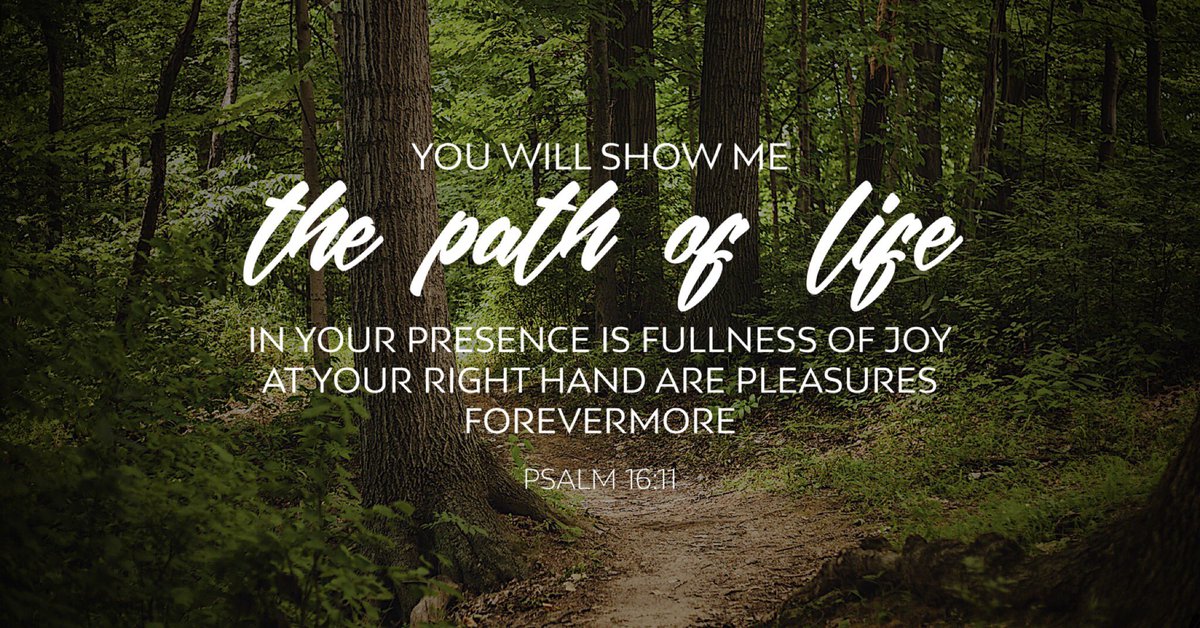
Image result for you will show me the path of life

I believe he means that a path of life rooted exclusively in Jesus Christ (John 14:6) establishes us in Him in the same way a branch is established in the vine from which it grows, and that is the only source needed for sustenance (“sunshine” and “rain”), for now and for eternity.  Faith allows us to rest in that reality, despite the swirl of circumstances.  Of course, we are always tempted to step out of that grace in times of worry, impatience and rushing to help GOD move things along, which is why we have reminders such as these:

“Cast your cares on the LORD and He will sustain you; He will never let the righteous be shaken.” (Psalm 55:22)

“Come to me, all you who are weary and burdened, and I will give you rest.” (Matthew 11:28)

“…Be of good cheer; I have overcome the world.” (John 16:33)


“My grace is sufficient for you, for My strength is made perfect in weakness.” (2 Corinthians 12:9) 


“Cast all your anxiety on Him because He cares for you.” (1 Peter 5:7)


These are more than comforting, sentimental sayings, they are declarations of the call to be in and remain in vine life so that the work of the Kingdom is done thoroughly in us and through us.  They are reminders that our reality is the Vine which is Christ Jesus, and to not be swayed into believing and acting in dependence on some other “truth.”  To quote Taylor, “Let us so abide in the Lord Jesus.”

© Byron L. Hannon, 2018. All rights reserved for text content.
All Are Welcome

“And let them make Me a sanctuary, that I may dwell among them.” – Exodus 25:8

 Given my theological orientation, the doctrine of sanctification carries special weight with me. I believe GOD calls us all to a salvation experience through Jesus Christ (addresses the consequences of our sins), and then, in simple terms, He calls us beyond to a Holy Spirit-empowered and guided life in Jesus Christ marked by willing, loving, complete, obedient submission to His Lordship. I could say more, much more, but this post is not for the purpose of systematic theology. It is about one particular aspect of the Church.

In addition to having been a pastor in a local church, I have visited quite a few over the years, occasionally to preach, but more often to simply enter into a house of worship, enter into the fellowship of worship with other believers, and to hear and be challenged by the proclamation of the Word of GOD. Unless those visits were in churches where I was known, I didn’t volunteer anything about being a pastor or even that I was a Christian. If someone asked, I’d tell them, but I’m not otherwise interested in promoting any bona fides; I just wanted to hang out in church.

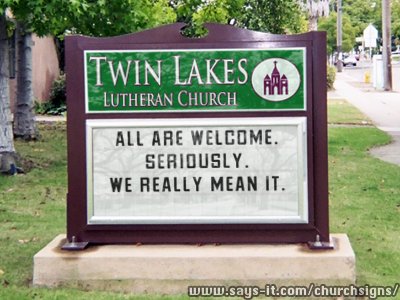
Image result for church sign all are welcome

Essential to each of these experiences was whether I was actively and intentionally welcomed, whether I felt welcomed.  I don’t have enough fingers or toes to count the church signs I’ve seen that said, “All Are Welcome.”  But the only way to really know is to go inside.  Most times when I have gone inside have been positive, but there have been a few times when that wasn’t the case.  Those particular buildings all had what many refer to as sanctuaries, but they weren’t sanctuary spaces for me.

Image result for word families

The words “sanctuary” and “sanctification” are more like siblings than first-cousins. They both concern that which has been set aside, exclusively, for holy use.  In the case of “sanctuary,” our normal usage refers to a holy or consecrated space for the purpose of worship or refuge.  A chorus I know, sings:

So forget about yourself and concentrate on Him,

And worship Him.

So forget about yourself and concentrate on Him,

And worship Him.

So forget about yourself and concentrate on Him,

And worship Him.

Worship Him, Christ the Lord.

 Can anyone forget about themselves when they don’t feel welcomed, when they don’t feel emotionally safe? That is what I and anyone/everyone should experience when we enter GOD’s sanctuary.  It should be a place where you and I have temporary refuge from the cares and weighty issues of life and experience peace because it is holy for that purpose.  Sure, I’m more likely to experience that when I enter into the sanctuary of my “home” church, but what about the person who has no church home?  What about the visitor (believer or unbeliever) who is searching for the presence of the Holy, whether they know it or not?  This is a legitimate spiritual need and calls local church leaders to a level of awareness and sensitivity beyond what works for them and the usual crowd associated with that particular church.

Image result for whole counsel of god

I want to be careful to not neglect what I believe to be another way to view this issue. I generally don’t prefer the King James Version of Scripture, but, in the case of the verse above, the phrasing suggests that GOD, Himself, wants to be our sanctuary.  The context of the immediately preceding verses points to the construction of a physical sanctuary as the intended understanding, and I respect that.  However, when viewed through the lens of all of Scripture, I think the idea of GOD desiring to be a sanctuary for His people is a settled issue.

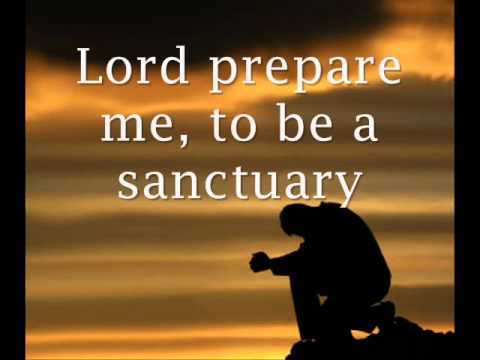
Image result for make me a sanctuary

As an extended point, I believe that those made in the image of GOD, redeemed and reborn through the blood of the Lamb, should increasingly have the characteristics of sanctuary themselves. They are people who offer others temporary respite and refuge from the weights we all carry because they spend significant time in the presence of GOD, and His holiness is present in them.  They are sanctuaries on two feet, and the world needs them desperately.  If you’ve been around such people, you know what I’m saying.

People gravitate to where they feel safe, comfortable and cared for, and that includes where and with whom they worship and/or choose to be in relationship with. The converse is also true.  Church signs often say “All Are Welcome? Are all welcome or is that welcome conditional?  Local church greeters and each of us, individually, communicate both conditional and unconditional welcome.  Our smiles, extended hands, open hearts and genuine interest attract; our blank faces, frowns, grudgingly offered or withheld hands, and cursory interest don’t attract.

Image result for God has room 

GOD never has a “No Vacancy” sign in His Kingdom; we shouldn’t either.

© Byron L. Hannon, 2018. All rights reserved to text content.


That Hope Don’t Float

“Therefore my heart is glad, and my glory rejoices: my flesh also shall rest in hope.”                                                                                                                            – Psalm 16:9

I recently went to a Philadelphia theater to see a play that, not too long ago, had a successful off-Broadway run. The play’s theme was darker than I ordinarily gravitate toward, but I was highly motivated to see it because of an interest in the subject matter, and because I know one of the actors. On a starkly bare white stage, three men and a boy, barely into his teens, appear one by one over the course of a half-hour or so. Each is confused and uncertain. Slowly and with varying degrees of resistance, they come to the realization that they are there because they have been unjustly killed by gunfire. It is quickly apparent that none of them knew any of the others prior to their deaths.

Image result for kill move paradise

This new existence of theirs is purgatory-like, and is accompanied by a set of instructions they must collectively follow to experience an unspecified transformation that would allow them to leave the confining, controlling space represented by the stage. As portrayed by the actors, getting to this point wasn’t easy because each of them had to go through stages of grief in a way that synced with their different personalities. Each exhibited varying degrees of denial, anger, depression and, finally, acceptance (I don’t recall any bargaining to return to their old life). This process of emotional transition often involved directing their frustration and anger at each other with great intensity.

Image result for negative emotions

Eventually they, together, reached a mental and emotional space that signaled they were ready to move to a place conducive to a transformed life. Although the new place of existence was largely unspecified, the play ended with, what was a surprise ending to me: the cast repeatedly singing a rousing chorus to the audience, borrowed from John 14:2:

                                      In my Father’s house, there are many mansions.                                                                    If it were not so, I would have told you.

 The cast then runs off-stage together, and the stage lights grow dark…The end.

The play’s conclusion was one of hope for these three men and one boy. The ending didn’t change the horror and sadness of the “how” or “why” of what happened to them, but it suggested a hope in the possibility that earthly life’s unjust circumstances do not have to dictate the “forever” for the characters or the many, who in real life, have suffered comparable fates.

Image result for dialog

In an unusual move (in my limited experience), the actors made themselves available to debrief with any audience members who wished to stay afterwards. A good number remained, and a dialog followed, mostly about the issues that led to the deaths of the characters and how various audience members internalized the experience.

One audience member commented, however, that she thought the ending was “too neat” and wasn’t reflective of reality.  There was a strong undertone in her comments indicating that she didn’t like the Christian vibe to the play’s ending. In other words, the kind of hope portrayed didn’t float for her. I sensed she wanted the play to show a resolution to the unjust actions that had taken the characters lives, a resolution that she could see and feel, one more rooted in tangible human experience.

I understand. How often I have wanted GOD to fix the hurts, disappointments, and sorrows of people I have shepherded. I often have felt so inadequate to comfort them and hungrily desired the power to fix their problems myself. Too often I have experienced these same feelings as a husband, father, and grandfather when my dearest loved ones have been in the furnace of difficulty and grief, and it seemed my only recourse was to cry out to GOD.  Always, I cry out to GOD.  And the reason I do this is because of the hope I have in Him, something that lady seemed to lack.

Image result for cry out to GOD

It would be great if all of this life’s difficulties were resolved in a way we could see and feel, and sometimes it is. But often, it isn’t. The question, then is, what options are left?

  • A human-produced resolution based on mutual goodwill, our common humanity, and our ability to reason together?;
  • A fatalism in which we throw-up our hands in resignation?; or,
  • An anger that offers no outlet other than sin (Psalm 37:8; Eph. 4:26)?

Image result for that dog don't hunt

There’s an old southern expression that describes ineffectiveness in a rather poignant way: “that dog don’t hunt.” I think time and experience proves that these three bullet-pointed “dogs” don’t hunt…they don’t hunt at all or not well enough to place the fullness of hope on them.  I choose hope in GOD.  Hope may not always dispel anger at unjust things, but hope does give us (and our anger, hurt, disappointment, etc.) a godly outlet.  I choose hope.

© Byron L. Hannon, 2018. All rights reserved for text content.
Why I Pray

“To what profit is it that we dwell in Jerusalem, if we do not see the King’s face?”                   – David Macintyre 


Image result for psalm 130

Long has been my practice of prayer, whether it be in public settings, in the midst of family, or in the private places when GOD is my only partner.

Common to the vocation of pastor is the legitimate need to pray for the known and even unknown needs of the congregation, to offer thanks for GOD’s many blessings, to set the tone that enables others to enter into needed confession, to intercede on behalf of those facing heavy trials or who are in the midst of crisis, to comfort the ill and the hurting, to acknowledge the grief of those in mourning, to solemnize the joining of the newly married, and to pronounce blessings on GOD’s people just before they leave the sanctuary to reenter the fray of daily life.

Of course, I’ve attended many prayer meetings over the years, learning and practicing different prayer forms that have been part of the Church legacy for two millennia. And in my pastoral role, I have led these same meetings.

I’ve been asked, like most pastors, to pray at public events even when the sponsoring organizations or event purposes were not Christ-centered or oriented.

My wife and I pray together daily, and our children and grandchildren join with us whenever we’re together. From time-to-time, I’ve even been the unofficial, designated prayer-giver at extended family events.

Image result for prayer incense

Each occasion is a great privilege. My greatest joy, however, comes during those times when it’s just GOD and me.  For me, these times remove the cliché aspect from “having a personal relationship with GOD” because each opportunity is deeply personal and relational.

Why do I do it? Because I want, like David Macintyre says, to see the King’s face.  It’s not enough for me to know that He’s there; I want to experience communion with my Creator.  I’m thankful for my rational mind and its ability to grasp enough of the reality of GOD to have faith in Him, but my mind is not the sum total of who I am, it is one part.  I also have a heart, a soul.  I desire that all of me know GOD…and that I hide nothing of myself from Him.  I want the Holy Spirit to guide me through the interior castles of my heart and discover whatever GOD want to show me about Himself and about me (Interior Castle is a classic of Christian literature by Teresa of Avila, circa 1588).

Image result for prayer

In these times (usually in the early morning darkness or first light), I want to move beyond reasoning about GOD and enter into the mystery of the eternity He commands. I want to present myself to Him and wait for Him, in the same way my childhood self used to wait for my father to come home from work.  I want to hear what He chooses to say, if He chooses to speak.  And even if He chooses not to speak, to know that He is there and is content with me patiently waiting for Him.  At times He has given me words of assurance, sometimes correction, and sometimes direction.  He has even surprised me with an overwhelming sense of His presence so powerful that I wasn’t sure I could bear it.  Every time He has revealed Himself, it has always been about some aspect of Himself I may have been inattentive to, my inner need, or the inner need of someone else.

Several days ago, I became acutely aware of being in the courts of heaven while I was praying. This certainly wasn’t a physical change because I was also aware of being seated in the same place I was when I first started praying.  This change was more of an inner awareness of position and presence.  I’ve never experienced this before, and I’m not sure how to better describe it.  As soon as I realized what I was experiencing, passages of Scripture about our true citizenship being in heaven began racing through my mind.  I’ve been tempted to speculate about why this happened, and perhaps GOD will make it clear some day.  For now, I’m going to treat it as a love gift, and say “Thank you, Father.”

Image result for ascent psalm

Psalm 130 is an ascent psalm, meaning that it was written as a song to be sung by the Jewish pilgrims as they traveled to Jerusalem to celebrate one of the great annual feasts. Verse 7 says, “Israel, put your hope in the LORD, for with the LORD is unfailing love and with him is full redemption.” This same Lord is my GOD, the loving One whose redemption goes far deeper than I can think or imagine. So if I’m going to go to Jerusalem, it only makes sense to want to see His face. That’s why I pray.

© Byron L. Hannon, 2018. All rights reserved for text content.

True Treasure

“…So that they may have the full riches of complete understanding, in order that they may know the mystery of God, namely, Christ, in whom are hidden all the treasures of wisdom and knowledge. – Colossians 2:2-3

 I was asked, several months ago, to teach a course on Christian Ethics to students preparing for pastoral ministry.  Our first class session was a few days ago.  This is the second time I’ve taught this course, but I have a greater appreciation for its particular relevance given our times, as well as for the obvious and, more often, subtle issues facing pastors and church leaders.

Image result for christian ethics

I, and every pastor I know, have been confronted by ethical issues, including those that involved degrees of complexity. Most of these involved the choices others made or wanted to make, and I became necessarily involved, usually as the recipient of the problem, the problem-solver or the decision-maker.

Related image

Early this past week, I spoke with a pastor-friend who has just such an issue facing him, and it’s a doozy. He called because he wanted my take on a way to proceed.  We bounced around a few ideas, and ended our call after we both committed that he would continue to offer the problem to GOD in prayer, and that I would join with him in this.  In a semi-facetious way discussion of Moses, in some of his more melancholy moments, occupied a few minutes of our phone time.

How much of our lives require understanding and wisdom, whether we’re trying to solve an ethical issue or just for everyday living?  How easy it is to miss the scope of the need to be wise, to be oblivious to the depth of our need for any number of reasons.  How easy it is, for example, for drift to cause us to have an out-of-tune spiritual mind.  The Shema (Deuteronomy 6:4-5) and what many refer to as the Great Commandment (Matthew 22:37) links faithfulness with loving GOD with all of our being, including our minds.  At the very least, this means the Spirit-enabled capacity to understand that GOD is the ultimate reality (even if we don’t know all of the details), to reason that He has a will for all of creation, including us, and choosing to align our will with His will.

Image result for mother crossing street with child

When my mother used to insist that I hold her hand when we crossed the street, holding it tightly, I wanted to pull away because that tight hold felt restrictive. It wasn’t until much later that I realized that her interest and her action was for my well-being, and her ability to see what was coming from both directions far exceeded mine.  Feel free to substitute GOD in this equation as it pertains to your life.

Those of us seeking a right life owe it to ourselves and to GOD to recognize that His commands, though they may feel restrictive at times, are for a reason: our best interests. The truth is that He knows better than me (and you).  Imagine me snatching my hand from my mother’s hold!  Hint: She grew-up in the South during the Depression and was “old school” in how she approached child discipline.  I might of thought of pulling away, but I didn’t; I knew better.

Do we know better with GOD to not pull away, to not try to go our own way? All (or most of us) say we want to glorify Him; our submission and obedience does this very thing.

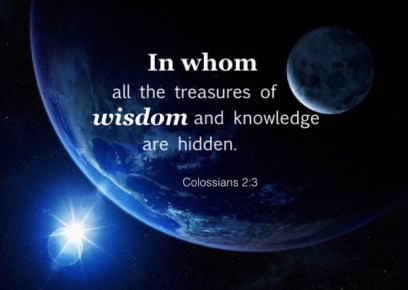
Image result for treasure of wisdom

2 Peter 1:3 says that GOD’s divine power has given us everything we need pertaining to life and godliness. Most of all, He gave us Jesus, the Treasure of Heaven, in whom is found all knowledge and wisdom.  What treasure is greater than this?  I will let Him hold my hand.  I need Him to hold my hand.

© Byron. L. Hannon, 2018. All rights reserved for text content.

On Growth

“The problem of speeding up the movement of a vehicle is that of applying power to overcoming friction.”- Mary Petre Bruce

Image result for mary petre bruce

I had never heard of this British woman, Mary Petre Bruce, who raced cars and speedboats in the 1920s and 30s. She was also the first woman to solo circumnavigate the globe by air in 1930 after learning how to pilot a plane.  She had a love for speed.

Racing is not on my list of interests, so it is highly unlikely that I would have ever come across her name or this quote had it not been referenced in a devotional writing by Amy Carmichael, an Anglican missionary to India who passed away seven months before I was born. Hers (Carmichael) is such a simple concept, using Bruce’s example of the physics that cause a heavily weighted vehicle to gain significant speed, to explain what is required for spiritual growth in humans.

Spiritual growth is something that has long been on my list of priority interests as a working pastor; and it still drives me as one who desires to influence people for Christ.  Quite simply, sustained spiritual growth (building-up speed) requires overcoming whatever friction-producing hindrances and obstacles that, by their very presence, inhibit growth.

Image result for hindrance

What are the sources of that friction? In a vehicle, we can assume weight, air resistance, the quality of the fuel, the tune of the engine, and the design and smoothness of roadway to name a few.  Spiritually, perhaps the most obvious is complacency.  A paraphrased and simply profound sentence from a friend’s book is this: There are always some Christians who are no further along in their faith walk than they were ten years ago.  I know many spiritual leaders who would agree with this.

While there a number of other reasons for the obstacle of friction aside from complacency, complacency is a problem in the Church. I’ve had congregants take the position that they are “okay where they are.”  I’ve witnessed many who have not been open to being discipled as well as having a lack of interest in exploring the historical practices of the faith that contribute to growth, even the most common and obvious ones.  This is not my unique experience.

I believe (and Scripture and experience teaches) that GOD is inexhaustible, and if that is true, we can never learn enough about Him nor can we reach a point where there is nothing more He can do for us, in us and/or through us. Therefore, it was and is incumbent upon those who call Him Father to keep growing.  He deserves that if, in fact, He is all the superlatives of praise we sometimes too casually heap upon Him in our worship services.

Newton’s first law of motion, sometimes referred to as the law of inertia, is a two-parter.  Part one says that an object at rest stays at rest unless acted upon by an unbalanced force.  This is the picture of the complacent believer.  He or she requires something special, an “unbalanced force” to move them from that position of complacency.

Other sources of friction may include conflicting priorities (e.g., the counter-influence of family members/friends or career concerns), other forms of idolatry, insecurity about having the competency to grow, fear of where growth might lead (a reason actually given to me was, “What if GOD wants me to become a missionary in Africa”?), unresolved emotional entanglements, and the influence of bad theology.  I’m sure I’ve missed a few.  Time and space doesn’t allow for more comment on these.  Let it suffice, for the moment, that these are real obstacles that must be overcome to experience spiritual growth.  Jesus and His apostles spoke on each of these and of their remedy.

The second part of Newton’s first law, converse to the first part, says: an object in motion stays in motion with the same speed and in the same direction unless acted upon, again, by an unbalanced force.  This more closely resembles the ever-growing believer.  Growth begets growth, after a seed of its own kind.

Image result for after a seed of its own kind

Meditating on the concept of overcoming friction with power to obtain speed, brings  me to the work of the Holy Spirit, who is the source of the Christian’s power. Here are a few related thoughts:

  • Joel prophesied about GOD’s intent to pour out His Spirit on all human flesh in a way that would manifest power (Joel 2:28-29).
  • It was Jesus who said to His disciples, But you will receive power when the Holy Spirit comes on you; and you will be my witnesses in Jerusalem, and in all Judea and Samaria, and to the ends of the earth” (Acts 1:8).
  • Throughout the Acts of the Apostles, believers are urged to receive the Holy Spirit, not just His immediate presence as a consequence of salvation, but the fullness of His power so that we would be walking witnesses for the Kingdom of GOD.
  • Walking according to the Spirit (Romans 8:4) and walking by the Spirit (Galatians 5:16) are two of Paul’s contributions to this dynamic that is in direct conflict with the idea that no or low growth is condoned by GOD.

There’s no teaching here that is unique. These are words that have been heard and read in the Church since its inception.  What is different is how someone who had no apparent interest in teaching a spiritual lesson by explaining a physics problem so easily captures a spiritual reality that has contemporary and eternal implications.

The sources of friction I named earlier and even the ones I neglected to name are real and very human, but both the 1st century Christian and the 21st century Christian are called to overcoming lives.  If our GOD is truly a supernatural GOD and “able to do exceeding abundantly more than we can ask or think,” it will always be according to His “power that works in us” (Ephesians 3:20).

Let’s pick-up the speed.

© Byron L. Hannon, 2018. All rights reserved for text content.


When Christians Pick Sides

“I hear that when you come together as a church, there are divisions among you, and to some extent I believe it.  No doubt there have to be differences among you to show which of you have God’s approval.” – 1 Corinthians 11:18-19

I don’t think there are many things more discouraging to church leaders than to see  divisions in their church. I don’t mean simple differences of opinions.  Whenever you get more than one person in the same room, it’s guaranteed that a difference of opinion will surface, whether it’s something minor like favored sports team or even more significant like candidates for political office.  What I’m talking about are those divisions that result in a break in fellowship (or which reveal that biblical fellowship never existed).

Image result for church division quotes

Whenever I think of the church in Corinth, awareness of their immaturity and carnality surfaces quickly. So much of what Paul wrote to them in his first letter dealt with the superficiality of their faith which too often revealed itself in unrighteous attitudes and behavior.  In the passage referenced above and in succeeding verses, he points to a serious deficit in their regard for each other, particularly toward poorer members of the church, when they came together for the Lord’s Supper, one of the times when the unity of the church should be a defining mark.

Image result for corinthian church communion

We know from reading the first chapter of this letter that one of the sources of division in the Corinthian church was based on which Christian “personality” (Paul, Apollos, Peter, Christ) church members aligned themselves to. I read all of this, and almost feel the disgust that Paul feels because he’s got to try to nip this junk in the bud to protect the infant church from itself as it struggles to grow in maturity and strength and to protect the integrity of the church’s testimony to an unbelieving world.

In the years since this letter to the Corinthian Christians, how far have we come? I think a long and good way in many, many ways.  But I’m also cognizant that “the thief comes only to steal and kill and destroy…” and one of the ways he does that is to get us to divide ourselves into factions that reveal the absence of fellowship and a lack of interest in being in fellowship.  Are there Christians with whom I cannot be in fellowship?  What about you?  Do they exist?  If the answer is “yes,” then maybe Paul is talking to us, too.

Image result for heresy

I find it telling that the same word used for “divisions” or “factions” is used for the word “heresy,” because when Christians take competing sides on issues that have little to do with GOD’s love, with GOD’s redemptive cares, with GOD’s word (our truth), with GOD’s will (our path), when we exchange any side for GOD’s side, this has the effect of distracting people and pulling them away from the faith which is, fundamentally, what heresy is.

Image result for church problems

Our humanity allows us to connect emotionally with other people, issues and other things with a capacity that is probably much deeper than we are aware. A stewardship responsibility comes with this wonderful ability.  We need GOD’s help in discerning the issues to which we align ourselves, particularly when they have the potential to separate us from others.  Not everything out there and available for us to sign-up to is from GOD nor necessarily pleasing to Him, and constitutes “junk” that needs to be nipped in the bud before it damages the church and its testimony.  John the Apostle says much the same thing when he says, “Dear friends, do not believe every spirit, but test the spirits to see whether they are from God, because many false prophets have gone out into the world” (1 John4:1).

Doing this will help us get on and stay on GOD’s side.

© Byron L. Hannon, 2018. All right reserved for text content.


© Byron L. Hannon, 2018. All right reserved for text content.

An Economy of Enough

I’ve been thinking about the economy lately, more than I typically do. I usually don’t spend a lot of time reading the business pages or listening to business commentary on TV, but it’s drawn my interest lately.  I know the reason: it’s because of the conflicting speculations of various economists about the current state of our economy and likely scenarios for the near future..

Image result for bull or bear market

Some are saying that our economy is due for a downturn after a longer than typical period of expansion. Many of these same experts suggest that current and future trade wars between nations are certain to contribute to this downturn; they are projecting continued increases in interest rates and job losses in industries most affected by the imposition of tariffs.

Other economists and financial experts are predicting the exact opposite, saying that the economy is strong enough to absorb the impacts of the tariffs, that the Federal Reserve will keep inflation in check, and that continued growth is likely because other economic indicators point in that direction.

Maybe some of this is outside of your interest level or what you deal with or care about on a day-to-day basis, but hang-in with me. There is a point.

Image result for scarcity or abundance

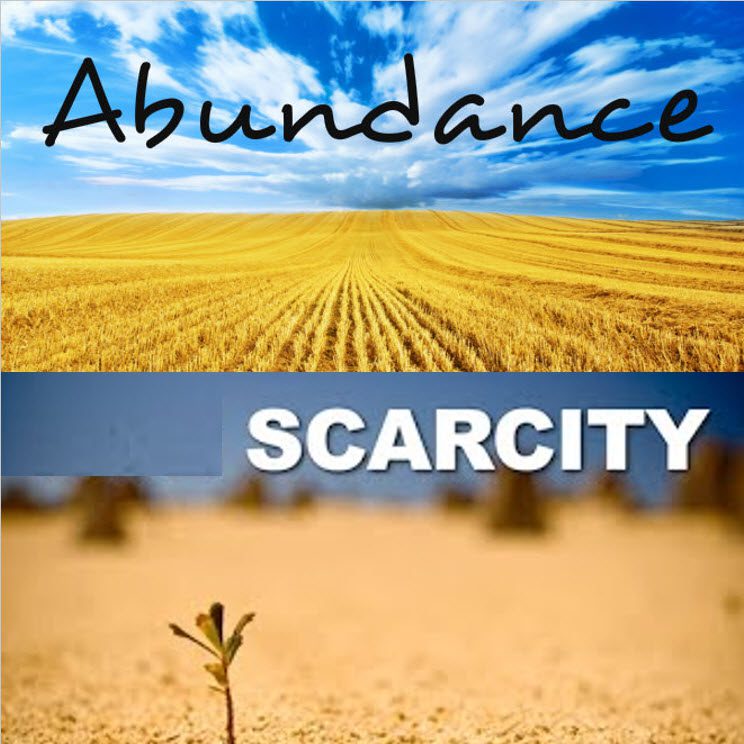
Thinking about these things reminds me of a recent blog post by Richard Rohr1 in which he talks about the difference between what he calls the “Economy of Scarcity” which is the economic basis for virtually every nation in the world, including ours, and the “Economy of Abundance” which marks the Kingdom of GOD.  In his post, Rohr says that world economies operate on the belief that there is only so much of everything to go around.  Resources are limited, and a necessary aspect of reality is that those who gain control of the largest amounts of these scarce resources are positioned to dictate how the world operates.  This line of thinking is a perfect reflection of a perverted golden rule: “Them that has the gold rules.”

A consequence of this is that institutions (and some people) work to garner and control as much of these scarce resources as they perceive are needed to support the agendas they value. In an ideal scenario, the agenda would be to benefit the common good of all, but too often, the common good has not been the primary agenda.  A pattern in human history shows that the hoarding of resources has been paralleled by the hoarding and use of power needed to protect those resources and the ability to control them.  The overflow has been conflicts of various levels of intensity resulting at every level of human society.  Exclusivity, elitism, structures of haves and have nots, caste and class systems, and a number of isms are by-products of these concerted activities to control and distribute wealth in inequitable ways.

Image result for feeding of the 5000

Fr. Rohr points to the “Economy of Abundance” exhibited by Jesus as a rebuke of the “Economy of Scarcity.” One example he cites is the feeding of the multitudes found in Matthew 14 and Luke 9.  It’s been estimated that somewhere in the area of 12,000 to 15,000 people (the count of 5,000 refers to the men present) had been following Jesus on this occasion, and there was a need for them to eat.  Jesus instructed His disciples to feed all of these people.  They were dumbfounded and replied “We have only five loaves and two fish,” which they had gotten from a young boy.  We all know what Jesus did (or I assume you know; if not please read the account in the Bible).

If we lay aside, for a moment, the miraculous aspect, and focus on the difference between Jesus and His disciples, we see the two mental models at work. The mental model of the disciples was an “Economy of Scarcity:” “We only have…That’s all there is…There’s only so much to go around…Nothing close to meeting everyone’s need can happen here and now.” Jesus’ mental model was centered in the Kingdom of GOD, where there is never a shortage, there’s always more than enough…and that’s what was witnessed that day, for after all the people were filled there was enough left over to fill twelve baskets.  There was abundance.

Image result for rich young ruler

Another example is that of the “Rich Young Ruler” (Matthew 19) who approached Jesus one day wanting to know the path to eternal life. After some back and forth, Jesus told him to sell all his possessions, give them to the poor, and then follow Him (Jesus).  The man balked, and left dejected because he had an attachment to his material wealth that would not (1) allow him to give it to those who had little or no wealth, and (2) place his trust in the One who knows no lack and whom all of Christianity (and Judaism along with Islam) claims is the Lord of all creation.

I admit, I’m still mulling over this, wondering how much of my life has been limited by an assumption that the “scarcity” model is the only model or the right model. I think about that, but I also think about whether the “abundance” model is beyond my reach as long as I’m still earthbound, or if my faith is just too small.

Image result for prosperity theology

I need to be clear here: I am not driven by a longing for a kind of prosperity that manifests itself in gaining material abundance, particularly as a sign of GOD’s favor. I reject that as theologically and biblically unsound.  I think it’s just another way of reinforcing the “Economy of Scarcity” model where “faith” is used to seek my portion of material gain.  Jesus and His disciples were still poor men, by the world’s standards, after the feeding of “the 5,000” and the subsequent feeding of “the 4,000” (see Mark 8).

When Jesus spoke of having come to “give life and give it more abundantly” (John 10:10), He was referencing abundance in a Kingdom context where there is an abundance of mutual love and peace and freedom from all sources of internal and external domination and where no one has to go without so that someone else can have more than they need. My term for that is “Economy of Enough.” Isn’t this the heart of Matthew 6:19-34 where Jesus speaks on earthly versus heavenly treasure and the foolishness of worry?

Still, I confess I’m trying to work through this and am not settled yet. Perhaps I need more of what Paul discusses in Romans 12:1-2 (transformation of my mental models).  Perhaps I need more of the Holy Spirit power that enables GOD to do exceeding abundantly more than I ask or think…according to the power at work in us (Ephesians 3:20).

In the meantime, I’ll try to be open to new ways to give myself away. GOD is worthy of that.

  1. Rohr, Richard, “Scarcity or Abundance.” https://mail.google.com/mail/u/0/#search/richard+rohr/164692d659020060. July 5, 2018.

© Byron L. Hannon, 2018. All rights reserved for text content.