Category Archives: Discipleship

A Vessel of the Lord’s

“I am the Lord’s servant,” Mary answered. “May your word to me be fulfilled.” – Luke 1:38

I was recently speaking with a friend who has known her share of troubles. From time-to-time, she has graciously shared some of them with me. As we were reflecting on her journey, there were tears intermixed with smiles and praises of how GOD has worked powerfully and surprisingly in the midst of her circumstances, producing wonderful outcomes. At the time, I wasn’t thinking of Mary the mother of Jesus; that came later.

Image result for mary mother of jesus

It’s easy to gloss over much associated with the Christmas story because we want to get to the ‘good part,’ the birth of Jesus. What we don’t focus on as much (largely because there is little biblical record) is the nine months between Mary being visited by the angel of the Lord and her delivery in a Bethlehem animal stall.

I can only speculate what it was like for the pregnancy of this teenage girl to become public knowledge.  I remember a little of what it was like for the teenage girls I knew who got pregnant out of wedlock in the 1960s when I was a teen; and that wasn’t pleasant at all for them. But how hard must it have been for Mary in the highly religious and rigid society of her day?  Death by stoning was the common judicial cure for what others might have assumed was her act of adultery (remember, her betrothal to Joseph was considered legally binding).

Image result for joseph and mary

That may well have happened if Joseph, who had his own angelic visitation, hadn’t protected her. Even then, who would have believed this poor girl if she did tell people the truth? We don’t know much about the arc of her story during those nine months, but human nature being what it is, we can at least guess that there was some gossip and some harsh comments aimed directly at her. But through her difficult journey and hard circumstances, GOD produced a wonderful outcome.

Image result for the anguish of mary

The difficulty didn’t end there for her, however. Her Son was ‘different’ from the other boys, even in ways she couldn’t grasp. I’m sure that created some ‘interesting’ social scenarios, and a kind of emotional pain particular to mothers. She had to hold onto the angel’s promise about her Son and the remembrance that she was highly favored by GOD. Years later, she would have to watch Him be rejected, mocked, brutalized and horribly killed. She had to hold onto the promise and the commitment she made that day way back when, “I am the Lord’s servant.”

I can’t imagine what she experienced when she first witnessed her resurrected Son. The Bible doesn’t tell us about what was shared between them during that 40 day period He walked among His friends before His ascension. Her joy had to be beyond the ability of words to describe.

I pray that kind of joyful experience for my friend who too is a servant of the Lord; and because of that, she holds onto the promises of GOD and keeps moving forward with hopeful expectation.

Years ago, another woman in the church I pastored led a woman’s study based on the book PREPARED TO BE GOD’S VESSEL, LESSONS FROM THE LIFE OF MARY.1 I obviously wasn’t a part of that study group, but I do have the book. What I’m continually reminded of by this book, by my friend’s experience, and by so many other experiences and events, is the fact that offering our lives to GOD as His servant makes us His vessel. And like all vessels, their use is at the sole discretion of the One being served.

Serving GOD produces the unexpected, the joyous, the fearful, the beautiful, the hurting, the wonder, the confusing, and many other emotions and experiences that cannot be named here. What both Mary and my friend discovered, however, is despite this sometimes roller coaster, there is great (supreme) value in holding onto GOD’s promises, and being faithful when you can’t see the end of things. What we have is the faith to believe that all will be well.

I am deeply grateful to know the story of one’s journey and to be able to watch the journey of the other.

My life is not my own                                                                                                                                                                                  To You I belong

I give myself

I give myself away.2

  1. PREPARED TO BE GOD’S VESSEL, LESSONS FROM THE LIFE OF MARY by Henry Blackabee and Carrie Blackabee Webb, Thomas Nelson Publishing, Nashville, TN, 2006.
  2. I Give Myself Away, Lyrics and Music by William McDowell, Copyright held by Delivery Publishing, 2008.

© Byron L. Hannon, 2018. All rights reserved to text content unless otherwise noted.

There’s Only Room for One

“I am crucified with Christ: nevertheless I live; yet not I, but Christ lives in me…”                    –  Galatians 2:20

 In past years, I would be knee deep in Advent preaching and preparation during this season. No longer having that responsibility but having others in its place, I have to admit that I’ve allowed my need to acclimate to my new duties to eclipse my awareness of the specialness of this season.  The truth is that between the busyness associated with this new role and taking some time off to celebrate a milestone event with my wife, I’ve paid scant attention to the season…until last night.

Image result for advent

Even then, I wasn’t thinking specifically about Advent as much as a theme that has occupied my focus for much of the past year: the idea that GOD is one (Deuteronomy 6:4), and the corollary commands that we, His people, are to love Him with all of our heart, all of our soul, and all of our strength, that we allow our lives to be subsumed in this love, and that we be diligent in teaching our children to do the same (Deuteronomy 6:5-9).

Isn’t this the reason for the first Advent?  Isn’t it to open the door of GOD’s grace to enable any and all to become united in this oneness and experience this love as an experienced reality (and not just an intellectualized doctrine), through the Person of Jesus Christ?  Isn’t this the thing Jesus prayed for in John 17? Sidebar: By the way, I purposefully used the present tense because GOD’s offer remains a present possibility.

Image result for no room in the inn

Advent is so much more than room being made in an animal stall for the Christ child, and the wonderment that followed. The location of His birth may have begun with a small accommodation by an innkeeper, but the gift of His life is GOD’s grand accommodation to us.

We need an exchange: His life for ours, for GOD’s offer is nothing less than the pathway to life. Paul, with his extraordinary statement in Galatians 2:20, makes this as plain as it can get: The  life of Jesus is life (“I am the way, the truth, and the life”- John 14:6).

Image result for i must become less so he can become more

When I consider what the Law and the Prophets say about Him, what He did and said, the testimony of His disciples, the teachings of His apostles, and my own experience of Him, I can only reach one conclusion: There’s only room for One. He emptied Himself for the sake of the Father; I must empty myself for His sake…and let His life occupy this room that I call me.  May it be so.

 Emmanuel, Emmanuel,                                                                                                                      

His name is called Emmanuel.                                                                                                      

God with us, revealed in us,                                                                                                            

His name is called Emmanuel.


© Byron L. Hannon, 2018. All rights reserved for text content except as noted.

Emmanuel copyright held by C.A. Music (Admin. by Music Services, Inc.), 1976.

Sight and Strength

“…She called for someone to shave off the seven braids of his hair, and so began to subdue him. And his strength left him. Then she called, ‘Samson, the Philistines are upon you!’  He awoke from his sleep and thought, ‘I’ll go out as before and shake myself free.’ But he did not know that the Lord had left him. Then the Philistines seized him, gouged out his eyes and took him down to Gaza. Binding him with bronze shackles, they set him to grinding grain in the prison.” – Judges 16:19-21

How often have you heard sayings like “Experience is the best teacher” and “It’s important to learn from your mistakes?” Less often do we hear, “It’s important to learn from other people’s mistakes,” although this path to learning can be extremely valuable. The Bible, particularly the Hebrew Scriptures (OT), has many stories purposefully placed for our benefit. We are to learn from them, but not necessarily repeat them. The Samson narrative is one of these. Set apart for a holy purpose before he was born, Samson was blessed with the supernatural gift of strength for the benefit of his people and for the glory of GOD. He used it to do mighty and astounding works.

Related image

One truth borne out of both anecdote and empirical study is that sometimes our greatest strength proves to be our greatest area of vulnerability and weakness. Samson was so far ahead of all others in physical ability that he lacked humility and failed to really recognize the source of his strength. This egoism made it easier for him to allow his appetites to control him rather than him controlling his appetites. And when he needed to be most teachable, he was not. Samson lacked the spiritual vision (insight) that should have accompanied his great physical strength. He never really demonstrated that he had “eyes to see” (Ezekiel 12:2). His lack of insight led to the loss of both his strength and his (physical) sight.

Image result for samson and delilah artwork

If you’ve been reading any of my previous posts, you know that I believe that the biblical standard for a healthy relationship with GOD is covenantal, that is intimate, permanent, and in full awareness of and response to (as much as humanly possible) the majesty of GOD and extraordinary work of grace extending to us through the blood of the Lamb, His sacrifice, His death, His resurrection and His ascension. Jesus is LORD in my book, and everything I am and can be, I owe to Him. My greatest purpose is to serve GOD after the model of Jesus, using the gifts and strengths given to me by His Spirit for that very reason. All else is vanity. Really, it is!

Image result for blurred sight

I don’t want to lose sight of this…and it is so easy to do. I don’t want this truth to be obscured by the things going on around me or whatever is going on in me…and it is so easy to do. I don’t want to become enamored by whatever it is I “bring to the table” with the grossly mistaken impression that I am my own source. That kind of attitude might result in “a thorn in the flesh” (2 Corinthians 12:7). Nah, I pass. I’d rather be ruled by the GOD who loves me and who gave Himself for me. I know that whenever I forget this, my strength bears no fruit and, while having eyes, I cannot see. This only brings joy to my enemy, like Samson’s failure brought joy to the Philistines.

Image result for samson artwork

I’m grateful that GOD is gracious and forgiving, even giving Samson one last victory. But how many more could he have had if his perspective had been different? Thanks for the lesson, Samson, I’ll try to keep learning from it.

“I love you, LORD, my source of strength!” – David, Psalm 18:1 (NET Bible)


© Byron L. Hannon, 2018. All rights reserved for text content.

Who Am I?

“…Who am I? Who am I? I am Jean Valjean…Who am I?  24601!”

Image result for les miserables 

This lyric is from a song in the musical version of Les Miserables, based on the book by Victor Hugo, first published in 1862.  If you’re unfamiliar with the story, this song is about the main character, Jean Valjean, wrestling with a moral dilemma.  He’s an ex-convict, who with the help of a priest, experienced a dramatic transformation in his life.  He has gone from being an angry, hardened, and violent man to a prosperous and respected professional.  He was a successful business man and mayor of his town.  His one misstep in that transition, however, was discarding the identity papers given to him upon his release from prison which he was supposed to present to anyone seeking his identification.  Because of the unjust and cruel reactions heaped upon him whenever he showed these papers, he tore them up and threw them away.  This act was a punishable crime.

In the course of the play, another man is mistakenly arrested and charged with his crime. Valjean’s dilemma is whether to allow this innocent man to unjustly bear his punishment or reveal the truth and sacrifice all he has achieved.  Thus the question: “Who am I?  Is his true self the businessman or the convict, ergo his prison identity 24601?  Valjean decides to reveal the truth and does.


Image result for who am i 

The question, “Who am I” is an ever present question for me, and I suspect many others. There is the “me” I was told I was by my parents; there’s the “me” my family thinks I am; there’s the “me” that others (including folks in the church) perceive or want me to be; there’s the “me” the enemy has, at times, tried to convince me that I am; there’s even the “me” I want to be.  And with each definition of “me” comes a set of expectations (someone else’s or the ones I self-impose). Of course, these various “me’s” don’t always align with each other, and at times that has produced some inner wrestling, a little like Jean Valjean.

Image result for saved by grace through faith

The experience and impact of GOD’s gift of salvation and His sanctifying work has confronted all of these “me’s” in different ways at different stages of my life, and has given me a completely different lens through which to view “me.”

A friend and I were recently talking about what it means to be a “bondservant” of Christ, a term we see frequently in the New Testament. In Scripture the status of bondservant was a voluntary, not a forced choice.  It was often chosen because the prospective servant loved the person they intended to serve.  Once service was volunteered and accepted, this was a lifetime appointment formed as a covenant relationship.  The bondservant was bound to one he or she served, and their life was subsumed (incorporated) in the identity and purposes of this person.

Image result for bondservant of christ

Who am I? I am a bondservant (doulos)  of Jesus Christ, a choice that I made years ago.  He knew me before I was in my mother’s womb.  He waited patiently for me, so that He could reveal to me who He called me to be.  He is the answer to “me.”  His way is my way.  His truth is my truth.  His life is my life.  There are other “me’s” available to me, but His is the one where my deepest joy, peace and purpose is found.  I know who I am.  How about you?

© Byron L. Hannon, 2018. All rights to text content are reserved.

Discerning Our Distractions

“Be dressed ready for service and keep your lamps burning…” – Luke 12:35

 Over the years, I’ve listened to folks from the generations preceding mine, and one of my conclusions is that for many of them, there wasn’t much time to be distracted.  Much of their lives were centered around ensuring the availability of the basic necessities to sustain relatively healthy and safe lives: shelter, food, clothing, and some mode of reliable transportation.  For some, formal education beyond early childhood was a luxury because helping to provide for the family was a higher priority.

Chatting with their neighbors while picking up the mail at the post office or as those same neighbors passed the house while walking down the street or listening to an evening radio program or playing with a ball and stick in the yard before the sun sank below the horizon might have been more typical of the distractions engaged in by my parents and grandparents during their earlier years. More sophisticated distractions required a more luxurious life than they had.

Compared to those generations, we have a wealth of distractions available to us, some of which I confess I enjoy…nothing sinful, but distractions nonetheless. I can only guess how my grandmother would have reacted if I showed her selfies of my friends and family on Facebook and Instagram, or if someone walking down the street bumped into her because they had their face buried in their phone.  Even as I write this, I’m fighting the urge to laugh at what I can nearly ‘hear’ her say.

Image result for distraction

Here are a few things available to many today that she and others from earlier generations would find astounding…and which multiply opportunities for us to be distracted:

  • The size of some contemporary homes allowing a person significant privacy away from other family members
  • Multiple bathroom households
  • Multiple vehicle households
  • Cell phones which do so much more than make and receive phone calls
  • Purchasing online with home delivery of purchases
  • Multiple TVs per home with one hundred+ show and movie options at any given time

I could go on, and perhaps there are some you think I should have listed.

Image result for distraction

There are times when we need to be distracted away from our obsessive behaviors or things that consume us so that we move points beyond the boundaries of physical or emotional health. Some distractions can help us regain needed balance.  And some are just flat out fun, and we need that from time to time.  But there are also those distractions that we may seek or to which we are susceptible, and which serve no good purpose.

2 Samuel 11:1 begins with “In the spring, at the time when kings go off to war, David…” delegated his responsibilities to another, and was free to pursue a distraction. I assume you’re familiar with the rest of this story so I won’t detail it other than to stress that not all distractions are “profitable” in the language of Paul (1 Corinthians 6:12).  Even distractions that are not, in themselves, inherently wrong may be wrong for us if engaging keeps us from that which is inherently superior, that is, whatever GOD wants from us or for us.

Related image

The lamps Jesus references in the passage above and in the parable of the ten virgins (Matthew 25) were small vessels capable of carrying a small amount of oil. They needed continual attention and refilling to remain useful as vessels of light.  Keeping them burning meant always having access to a supply of oil.  Jesus reminds us in the previous chapter (Luke 11:13) that the “oil” (the Spirit of GOD) is available to those who earnestly desire Him.  We need to seek Him; we need to seek Him to be baptized by Him in the fullness of GOD, and we need to seek Him to be filled with Him time and time again.

Am I preaching? Well, that’s what I am. What was true for 1st century believers is also true for us.  Apart from this filling and refilling, we will be consumed by the subtle distractions that are so numerous that we don’t need to seek them out; they will seek us.  Even the ones that we dismiss as harmless may cause us to be inattentive to the continual spiritual recharging we need.

Image result for viggo mortensen gi jane

In a scene from the movie GI Jane, Viggo Mortensen’s character, a Navy Seal Master Chief, confronted his Seal candidates just before a dangerous mission with a challenge framed as a question, “Who’s not ready?”  Jesus is saying the same to us, and challenging us to be ready for Him, however and whenever He chooses to manifest Himself.

I want to be alert to whatever GOD says, wants or does. A good friend said it this way, “I want to fear missing out on what GOD wants to do more than I fear missing out on anything else.”  I think this is a pretty good pathway of life.

© Byron L. Hannon, 2018. All rights reserved for text content.

Gentleness and Respect

“But in your hearts revere Christ as Lord. Always be prepared to give an answer to everyone who asks you to give the reason for the hope that you have. But do this with gentleness and respect…” – 1 Peter 3:15

How often are you asked by another to explain something, to justify something, or to account for something? When I don’t fully grasp a comment made by someone else or if I want them to say more, I’m prone to say, “Help me to understand that better” or “Talk more about that.”    It’s a habit I developed after years of interviewing people for jobs.  Similarly, I’ve had folks ask (or occasionally demand) the same from me.  And it’s happened in virtually every arena in my life: family, ministry, friends, past secular work roles, you name it; it happens frequently.

Image result for jerry springer show

Sometimes those events have occurred in moments of tension and pressure, times that make it easy to be defensive or, even, for putting someone else in a defensive posture. There’s nothing that activates what the Bible calls “the flesh” like pressure imposed from external sources (or maybe, internally generated).  The context in which I’m using this word, flesh, is the corruption of human nature that is revealed through the pursuit of our appetites and passions.  We can see this by turning the TV to the Jerry Springer Show (is that still on?) or any of the Housewives of (Pick the City of Your Choice). The verbal violence and occasional physical violence is “the flesh” exerting itself.

Image result for verbal anger

Have you ever told anyone off because they were getting on your last nerve? Yes?   Well, there you go – the flesh!

It’s not supposed to be that way with us, externally imposed pressure or not. An aged Peter (you remember that guy who used to be so impulsive) links revering Christ as Lord with how we respond to people, even in pressure situations.  There are three places in Scripture that come to mind that helps me understand what Peter means, and they are all supplied by his fellow apostle, Paul:

  • “But put on the Lord Jesus Christ, and make no provision for the flesh, to fulfill its lusts.” – Romans 13:14
  • “For as many of you as were baptized into Christ have put on Christ.” – Galatians 3:27
  • Let this mind be in you which was also in Christ Jesus…” – Philippians 2:5

Image result for Jesus and Pilate

I picture Jesus standing before Pilate knowing what was before Him.  The Lord’s attitude was one of gentleness and respect, the outworking of the life of the Father in Him in this otherwise dire situation.  Jesus is offering grace to Pilate even as He faces death.

It’s easy to miss the fact that Peter’s letter was written at a time the infant Church was experiencing persecution. He was challenging persecuted Christians to be gracious to those doing the persecution. I believe he is saying that if we have a truly reverent attitude toward Christ, it will result in the outworking of the life of the Spirit in us as we interact with others, including in times of tension and stress.  This outworking is the grace of gentleness and respect that so resembles Jesus, freely extended to those who otherwise might get a piece of our flesh-controlled minds, or even a stronger reaction.  I want a transformed mind, not one controlled by my flesh.

I’m thankful for those in my life who have modeled gentleness and respect toward me, and who have shown me Jesus, even when I didn’t reciprocate quite the same way.

I need to become less, so that He can become more.


© Byron L. Hannon, 2018. All rights reserved for text content.

A Personal, Personal Relationship

“…I am like a weaned child with its mother; like a weaned child I am content.”              – Psalm 131:2

 I have a problem with clichés…although I hesitantly admit that I do use them from time-to-time. The problem I have that is that they often reduce ideas, topics, and experiences down to a catchphrase that is, too often, so much more simplistic than the idea, topic or experience merits.  Saying to someone, for instance, that “GOD works all things to the good” when they are grieving a loss lacks sensitivity and is an untimely misuse of Romans 8:28.  Better to say nothing, and just offer presence.  What about this one: “Ignorance is bliss.” No, ignorance is dangerous.  I can think of other examples I’ve heard (and maybe even used), as I’m sure you can.

Image result for cliches

One that particularly grips me is when I hear someone say they have a “personal relationship with Jesus Christ” or when someone says to another that this “personal relationship “ is what they need. To be clear, I don’t quibble with the concept at all.  If I did, having this blog would be a gross contradiction.  My concern is what I perceive as the uninformed way I’ve heard that phrase bandied about.

CAN YOU SAY MORE ABOUT THAT?

On the occasions I’ve asked someone what having a personal relationship with Jesus Christ means to them, it’s been common to hear something along the lines of “It means that you’ve asked Jesus into your heart, asked Him to forgive your sins, you are made a new creation, and join the family of GOD.” I don’t want to be a jerk, so I try to frame my follow-up query, “Yes…and?” as graciously as I can.  It’s usually at this point that I get a few blank stares.  I want to know from them what else is going on that makes this important decision more than a transaction.  What, specifically, makes this a personal relationship?

Image result for i LIKE words

Like most writers I know, words are important to me; and words that relate to who we are in Christ and who we are called to be in Christ carry significant meaning. Jesus explained spiritual concepts in common, relatable language, including the heavy use of metaphors and similes, e.g. “The kingdom of heaven is like…” These are simple, clear ways to communicate the high value of the free gift of salvation in Jesus Christ.  These parables, however, are not simplistic because they don’t leave the hearer with an incomplete picture of the nature and extent of the offer.

Image result for mother and toddler painting

David’s simile (Psalm 131) paints a clear picture of the depths that personal relationship can go, in this instance the relationship between a mother and a toddler.  Apart from the abnormal circumstances which do exist for some people, unfortunately, most of us can relate to the depth of love and deep bond between a mother and child.  This is a relationship that lasts a lifetime, maturing as both mother and child grow older, but remaining the same at its core.  How many of you reading this have traits like your mother or father or both?  How many of you have been told, “The way you say that/do that reminds me of your mom/dad?”  Parental relationships run deep and leave an indelible, and very often, noticeable mark on each child.  Even as individuals, we are never so separated that we don’t remind others of those who birthed us.

David’s illustration is simple but it is not simplistic; it paints a vivid picture with varied colors of spiritual implication.  Yes, there were days when you/me/others made decisions that led to a spiritual transaction with GOD, but what else came with that?

I like David’s use of the mother/toddler picture because it puts my relationship with GOD in a much more realistic perspective. I need more than a covering for sin, and a position as a new creation.  I need to be the new creation that knows inherently that I am created for Him, that I am completely dependent on Him, and am happy to be with Him.  I want it to be deeply personal, not as a proposition but as a living reality.

Perhaps to eclipse the cliché, maybe I’ll start saying, “I have a personal, personal relationship with Jesus Christ,” just to be clear.

© Byron L. Hannon, 2018. All rights reserved for text content.

On Being

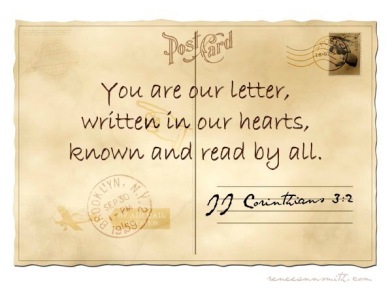
“You yourselves are our letter, written on our hearts, known and read by everyone.”             – 2 Cor. 3:2

 Like a lot of people who write, either as a vocation or avocation, much of my time is spent observing, processing, thinking/meditating and making conclusions. Occasionally, the fruit of that winds-up as a blog post. There are times, however, when I don’t want to do any of that; I just want to be.

Image result for introvert tired after socializing

After successive days of meeting with folks, either individually or in groups, with more to come and all for good reasons, and a snafu with some home improvements my wife and I just made, my introverted inner self is virtually screaming, “Enough! Leave me alone…at least for a while; I need to recharge.” I don’t want to think; I don’t want to evaluate and conclude; and I don’t want to expend any energy reducing things to 500 – 750 words for possible consumption by others. I just want to be. I’ve heard others say that from time-to-time, and asking “What does that mean?” seems fair.

The relationship between being and doing is a little tricky: what we are (being) determines the fruit we bear (doing), and conversely, the nature of what we consistently do influences what we are. Accepting the subjectivity of it all (because we each have our individual lenses, preferences, and inner wiring), I like Paul’s metaphor of being a “letter” available for anyone to read. Whether I speak or not, whether I write or not, I want to be someone “worthy of my calling,” not always seeking readers, but always available to be read.

Image result for 2 Corinthians 3:2

Still it begs the question, “What’s in my letter?” Centuries ago, Thomas à Kempis (a 15th century monk) wrote a series of devotional thoughts and exhortations that became the well-known book, Imitation of Christ©.  One of his prayers has resonated with me so much that I have it in my prayer journal, as a reminder:

Image result for thomas a kempis

Grant me, O Lord, to know what I ought to know,

to love what I ought to love,

to praise what delights Thee most,

to value what is precious in Thy sight,

to hate what is offensive to Thee.

Do not suffer [allow] me to judge according to the sight of my eyes,

nor pass sentence according to the hearing of ignorant men;

but to discern with true judgment between things visible and spiritual,

and above all, always to inquire

what is the good pleasure of Thy will. 


Sometimes, I just want to be; I would be content to be this.


© Byron L. Hannon, 2018. All rights reserved for original text content.

Another Paradox!

“I am the vine; you are the branches. If you remain in me and I in you, you will bear much fruit; apart from me you can do nothing.” – John 15:5


Image result for philodendron

 For years, my wife has had a philodendron in our living room directly in front of where I pray in the early morning. It has vines out of which grow branches producing heart-shaped leaves from which more branches grow, producing more leaves.  The discovery of a bud that will become a new branch or a new leaf beginning to grow from a branch is amazing to me, particularly as I reflect on the dependency that each branch has on its vine.  I often stare at this plant meditating on what Jesus said about dependency on Him, abiding in Him, and fruit-bearing for Him.  And despite my having done this for years now, it never gets old.

Image result for hudson taylor

The other day, I came across a quote from Hudson Taylor, a 19th century British missionary to China: “The branch of the vine does not worry, and toil, and rush here to seek for sunshine, and there to find rain. No, it rests in union and communion with the vine, and at the right time, and in the right way, is the right fruit found on it.  Let us so abide in the Lord Jesus.”

YES!…WAIT!…WHAT?

My initial reaction was to nod in affirmation at the truth of this, and to examine my own life in light of it.  A day later, reading it again, I began to have second thoughts.  Branches don’t have eyes to see the reality around them, like we do; their reality is the vine.  Branches don’t have jobs with bosses and co-workers who aren’t always the easiest people to be around, like we sometimes do; they don’t have our mortgages or rent to pay; they aren’t challenged by the occasional unruly sheep in the sheep pen (local church) who would rather behave like goats; branches aren’t concerned with other branches which choose not to cooperate in needed ways, like what sometimes vexes us.

Sure Hudson, that’s easy for you to say!

Image result for bible contradictions

I suspect that when people accuse the Bible of contradicting itself, it’s not contradictions as much as paradoxes that they choose not to explore

Related image

I believe Hudson Taylor’s statement is a paradox, meaning it is true despite having some seeming contradictions. Neither I nor you nor any of the saints whose lives are recorded in the Bible (specifically listed in Hebrews 11), or who have lived since are now or were ever free from life’s challenges, difficulties and hardships.  Jesus affirmed this reality (John 16:33), and both Peter and Paul addressed the issue of faithfulness in the face of hardships and persecution in their writings.

If I view Taylor’s statement according to this world’s way of understanding life, my only choice is to reject what he said out of hand. The world’s way, its truth, and its life demand that I (and you) become our own means of sustenance (“sunshine and rain” in Taylor’s words) through our own efforts (“rushing,” “worry,” and “toil”).  Independent, self-sovereignty is the world’s path of life, and is completely out of step with what Hudson Taylor says.

Image result for you will show me the path of life

I believe he means that a path of life rooted exclusively in Jesus Christ (John 14:6) establishes us in Him in the same way a branch is established in the vine from which it grows, and that is the only source needed for sustenance (“sunshine” and “rain”), for now and for eternity.  Faith allows us to rest in that reality, despite the swirl of circumstances.  Of course, we are always tempted to step out of that grace in times of worry, impatience and rushing to help GOD move things along, which is why we have reminders such as these:

“Cast your cares on the LORD and He will sustain you; He will never let the righteous be shaken.” (Psalm 55:22)

“Come to me, all you who are weary and burdened, and I will give you rest.” (Matthew 11:28)

“…Be of good cheer; I have overcome the world.” (John 16:33)


“My grace is sufficient for you, for My strength is made perfect in weakness.” (2 Corinthians 12:9) 


“Cast all your anxiety on Him because He cares for you.” (1 Peter 5:7)


These are more than comforting, sentimental sayings, they are declarations of the call to be in and remain in vine life so that the work of the Kingdom is done thoroughly in us and through us.  They are reminders that our reality is the Vine which is Christ Jesus, and to not be swayed into believing and acting in dependence on some other “truth.”  To quote Taylor, “Let us so abide in the Lord Jesus.”

© Byron L. Hannon, 2018. All rights reserved for text content.

That Hope Don’t Float

“Therefore my heart is glad, and my glory rejoices: my flesh also shall rest in hope.”                                                                                                                            – Psalm 16:9

I recently went to a Philadelphia theater to see a play that, not too long ago, had a successful off-Broadway run. The play’s theme was darker than I ordinarily gravitate toward, but I was highly motivated to see it because of an interest in the subject matter, and because I know one of the actors. On a starkly bare white stage, three men and a boy, barely into his teens, appear one by one over the course of a half-hour or so. Each is confused and uncertain. Slowly and with varying degrees of resistance, they come to the realization that they are there because they have been unjustly killed by gunfire. It is quickly apparent that none of them knew any of the others prior to their deaths.

Image result for kill move paradise

This new existence of theirs is purgatory-like, and is accompanied by a set of instructions they must collectively follow to experience an unspecified transformation that would allow them to leave the confining, controlling space represented by the stage. As portrayed by the actors, getting to this point wasn’t easy because each of them had to go through stages of grief in a way that synced with their different personalities. Each exhibited varying degrees of denial, anger, depression and, finally, acceptance (I don’t recall any bargaining to return to their old life). This process of emotional transition often involved directing their frustration and anger at each other with great intensity.

Image result for negative emotions

Eventually they, together, reached a mental and emotional space that signaled they were ready to move to a place conducive to a transformed life. Although the new place of existence was largely unspecified, the play ended with, what was a surprise ending to me: the cast repeatedly singing a rousing chorus to the audience, borrowed from John 14:2:

                                      In my Father’s house, there are many mansions.                                                                    If it were not so, I would have told you.

 The cast then runs off-stage together, and the stage lights grow dark…The end.

The play’s conclusion was one of hope for these three men and one boy. The ending didn’t change the horror and sadness of the “how” or “why” of what happened to them, but it suggested a hope in the possibility that earthly life’s unjust circumstances do not have to dictate the “forever” for the characters or the many, who in real life, have suffered comparable fates.

Image result for dialog

In an unusual move (in my limited experience), the actors made themselves available to debrief with any audience members who wished to stay afterwards. A good number remained, and a dialog followed, mostly about the issues that led to the deaths of the characters and how various audience members internalized the experience.

One audience member commented, however, that she thought the ending was “too neat” and wasn’t reflective of reality.  There was a strong undertone in her comments indicating that she didn’t like the Christian vibe to the play’s ending. In other words, the kind of hope portrayed didn’t float for her. I sensed she wanted the play to show a resolution to the unjust actions that had taken the characters lives, a resolution that she could see and feel, one more rooted in tangible human experience.

I understand. How often I have wanted GOD to fix the hurts, disappointments, and sorrows of people I have shepherded. I often have felt so inadequate to comfort them and hungrily desired the power to fix their problems myself. Too often I have experienced these same feelings as a husband, father, and grandfather when my dearest loved ones have been in the furnace of difficulty and grief, and it seemed my only recourse was to cry out to GOD.  Always, I cry out to GOD.  And the reason I do this is because of the hope I have in Him, something that lady seemed to lack.

Image result for cry out to GOD

It would be great if all of this life’s difficulties were resolved in a way we could see and feel, and sometimes it is. But often, it isn’t. The question, then is, what options are left?

  • A human-produced resolution based on mutual goodwill, our common humanity, and our ability to reason together?;
  • A fatalism in which we throw-up our hands in resignation?; or,
  • An anger that offers no outlet other than sin (Psalm 37:8; Eph. 4:26)?

Image result for that dog don't hunt

There’s an old southern expression that describes ineffectiveness in a rather poignant way: “that dog don’t hunt.” I think time and experience proves that these three bullet-pointed “dogs” don’t hunt…they don’t hunt at all or not well enough to place the fullness of hope on them.  I choose hope in GOD.  Hope may not always dispel anger at unjust things, but hope does give us (and our anger, hurt, disappointment, etc.) a godly outlet.  I choose hope.

© Byron L. Hannon, 2018. All rights reserved for text content.