Category Archives: Discipleship

Why I Pray

“To what profit is it that we dwell in Jerusalem, if we do not see the King’s face?”                   – David Macintyre 


Image result for psalm 130

Long has been my practice of prayer, whether it be in public settings, in the midst of family, or in the private places when GOD is my only partner.

Common to the vocation of pastor is the legitimate need to pray for the known and even unknown needs of the congregation, to offer thanks for GOD’s many blessings, to set the tone that enables others to enter into needed confession, to intercede on behalf of those facing heavy trials or who are in the midst of crisis, to comfort the ill and the hurting, to acknowledge the grief of those in mourning, to solemnize the joining of the newly married, and to pronounce blessings on GOD’s people just before they leave the sanctuary to reenter the fray of daily life.

Of course, I’ve attended many prayer meetings over the years, learning and practicing different prayer forms that have been part of the Church legacy for two millennia. And in my pastoral role, I have led these same meetings.

I’ve been asked, like most pastors, to pray at public events even when the sponsoring organizations or event purposes were not Christ-centered or oriented.

My wife and I pray together daily, and our children and grandchildren join with us whenever we’re together. From time-to-time, I’ve even been the unofficial, designated prayer-giver at extended family events.

Image result for prayer incense

Each occasion is a great privilege. My greatest joy, however, comes during those times when it’s just GOD and me.  For me, these times remove the cliché aspect from “having a personal relationship with GOD” because each opportunity is deeply personal and relational.

Why do I do it? Because I want, like David Macintyre says, to see the King’s face.  It’s not enough for me to know that He’s there; I want to experience communion with my Creator.  I’m thankful for my rational mind and its ability to grasp enough of the reality of GOD to have faith in Him, but my mind is not the sum total of who I am, it is one part.  I also have a heart, a soul.  I desire that all of me know GOD…and that I hide nothing of myself from Him.  I want the Holy Spirit to guide me through the interior castles of my heart and discover whatever GOD want to show me about Himself and about me (Interior Castle is a classic of Christian literature by Teresa of Avila, circa 1588).

Image result for prayer

In these times (usually in the early morning darkness or first light), I want to move beyond reasoning about GOD and enter into the mystery of the eternity He commands. I want to present myself to Him and wait for Him, in the same way my childhood self used to wait for my father to come home from work.  I want to hear what He chooses to say, if He chooses to speak.  And even if He chooses not to speak, to know that He is there and is content with me patiently waiting for Him.  At times He has given me words of assurance, sometimes correction, and sometimes direction.  He has even surprised me with an overwhelming sense of His presence so powerful that I wasn’t sure I could bear it.  Every time He has revealed Himself, it has always been about some aspect of Himself I may have been inattentive to, my inner need, or the inner need of someone else.

Several days ago, I became acutely aware of being in the courts of heaven while I was praying. This certainly wasn’t a physical change because I was also aware of being seated in the same place I was when I first started praying.  This change was more of an inner awareness of position and presence.  I’ve never experienced this before, and I’m not sure how to better describe it.  As soon as I realized what I was experiencing, passages of Scripture about our true citizenship being in heaven began racing through my mind.  I’ve been tempted to speculate about why this happened, and perhaps GOD will make it clear some day.  For now, I’m going to treat it as a love gift, and say “Thank you, Father.”

Image result for ascent psalm

Psalm 130 is an ascent psalm, meaning that it was written as a song to be sung by the Jewish pilgrims as they traveled to Jerusalem to celebrate one of the great annual feasts. Verse 7 says, “Israel, put your hope in the LORD, for with the LORD is unfailing love and with him is full redemption.” This same Lord is my GOD, the loving One whose redemption goes far deeper than I can think or imagine. So if I’m going to go to Jerusalem, it only makes sense to want to see His face. That’s why I pray.

© Byron L. Hannon, 2018. All rights reserved for text content.

True Treasure

“…So that they may have the full riches of complete understanding, in order that they may know the mystery of God, namely, Christ, in whom are hidden all the treasures of wisdom and knowledge. – Colossians 2:2-3

 I was asked, several months ago, to teach a course on Christian Ethics to students preparing for pastoral ministry.  Our first class session was a few days ago.  This is the second time I’ve taught this course, but I have a greater appreciation for its particular relevance given our times, as well as for the obvious and, more often, subtle issues facing pastors and church leaders.

Image result for christian ethics

I, and every pastor I know, have been confronted by ethical issues, including those that involved degrees of complexity. Most of these involved the choices others made or wanted to make, and I became necessarily involved, usually as the recipient of the problem, the problem-solver or the decision-maker.

Related image

Early this past week, I spoke with a pastor-friend who has just such an issue facing him, and it’s a doozy. He called because he wanted my take on a way to proceed.  We bounced around a few ideas, and ended our call after we both committed that he would continue to offer the problem to GOD in prayer, and that I would join with him in this.  In a semi-facetious way discussion of Moses, in some of his more melancholy moments, occupied a few minutes of our phone time.

How much of our lives require understanding and wisdom, whether we’re trying to solve an ethical issue or just for everyday living?  How easy it is to miss the scope of the need to be wise, to be oblivious to the depth of our need for any number of reasons.  How easy it is, for example, for drift to cause us to have an out-of-tune spiritual mind.  The Shema (Deuteronomy 6:4-5) and what many refer to as the Great Commandment (Matthew 22:37) links faithfulness with loving GOD with all of our being, including our minds.  At the very least, this means the Spirit-enabled capacity to understand that GOD is the ultimate reality (even if we don’t know all of the details), to reason that He has a will for all of creation, including us, and choosing to align our will with His will.

Image result for mother crossing street with child

When my mother used to insist that I hold her hand when we crossed the street, holding it tightly, I wanted to pull away because that tight hold felt restrictive. It wasn’t until much later that I realized that her interest and her action was for my well-being, and her ability to see what was coming from both directions far exceeded mine.  Feel free to substitute GOD in this equation as it pertains to your life.

Those of us seeking a right life owe it to ourselves and to GOD to recognize that His commands, though they may feel restrictive at times, are for a reason: our best interests. The truth is that He knows better than me (and you).  Imagine me snatching my hand from my mother’s hold!  Hint: She grew-up in the South during the Depression and was “old school” in how she approached child discipline.  I might of thought of pulling away, but I didn’t; I knew better.

Do we know better with GOD to not pull away, to not try to go our own way? All (or most of us) say we want to glorify Him; our submission and obedience does this very thing.

Image result for treasure of wisdom

2 Peter 1:3 says that GOD’s divine power has given us everything we need pertaining to life and godliness. Most of all, He gave us Jesus, the Treasure of Heaven, in whom is found all knowledge and wisdom.  What treasure is greater than this?  I will let Him hold my hand.  I need Him to hold my hand.

© Byron. L. Hannon, 2018. All rights reserved for text content.

On Growth

“The problem of speeding up the movement of a vehicle is that of applying power to overcoming friction.”- Mary Petre Bruce

Image result for mary petre bruce

I had never heard of this British woman, Mary Petre Bruce, who raced cars and speedboats in the 1920s and 30s. She was also the first woman to solo circumnavigate the globe by air in 1930 after learning how to pilot a plane.  She had a love for speed.

Racing is not on my list of interests, so it is highly unlikely that I would have ever come across her name or this quote had it not been referenced in a devotional writing by Amy Carmichael, an Anglican missionary to India who passed away seven months before I was born. Hers (Carmichael) is such a simple concept, using Bruce’s example of the physics that cause a heavily weighted vehicle to gain significant speed, to explain what is required for spiritual growth in humans.

Spiritual growth is something that has long been on my list of priority interests as a working pastor; and it still drives me as one who desires to influence people for Christ.  Quite simply, sustained spiritual growth (building-up speed) requires overcoming whatever friction-producing hindrances and obstacles that, by their very presence, inhibit growth.

Image result for hindrance

What are the sources of that friction? In a vehicle, we can assume weight, air resistance, the quality of the fuel, the tune of the engine, and the design and smoothness of roadway to name a few.  Spiritually, perhaps the most obvious is complacency.  A paraphrased and simply profound sentence from a friend’s book is this: There are always some Christians who are no further along in their faith walk than they were ten years ago.  I know many spiritual leaders who would agree with this.

While there a number of other reasons for the obstacle of friction aside from complacency, complacency is a problem in the Church. I’ve had congregants take the position that they are “okay where they are.”  I’ve witnessed many who have not been open to being discipled as well as having a lack of interest in exploring the historical practices of the faith that contribute to growth, even the most common and obvious ones.  This is not my unique experience.

I believe (and Scripture and experience teaches) that GOD is inexhaustible, and if that is true, we can never learn enough about Him nor can we reach a point where there is nothing more He can do for us, in us and/or through us. Therefore, it was and is incumbent upon those who call Him Father to keep growing.  He deserves that if, in fact, He is all the superlatives of praise we sometimes too casually heap upon Him in our worship services.

Newton’s first law of motion, sometimes referred to as the law of inertia, is a two-parter.  Part one says that an object at rest stays at rest unless acted upon by an unbalanced force.  This is the picture of the complacent believer.  He or she requires something special, an “unbalanced force” to move them from that position of complacency.

Other sources of friction may include conflicting priorities (e.g., the counter-influence of family members/friends or career concerns), other forms of idolatry, insecurity about having the competency to grow, fear of where growth might lead (a reason actually given to me was, “What if GOD wants me to become a missionary in Africa”?), unresolved emotional entanglements, and the influence of bad theology.  I’m sure I’ve missed a few.  Time and space doesn’t allow for more comment on these.  Let it suffice, for the moment, that these are real obstacles that must be overcome to experience spiritual growth.  Jesus and His apostles spoke on each of these and of their remedy.

The second part of Newton’s first law, converse to the first part, says: an object in motion stays in motion with the same speed and in the same direction unless acted upon, again, by an unbalanced force.  This more closely resembles the ever-growing believer.  Growth begets growth, after a seed of its own kind.

Image result for after a seed of its own kind

Meditating on the concept of overcoming friction with power to obtain speed, brings  me to the work of the Holy Spirit, who is the source of the Christian’s power. Here are a few related thoughts:

  • Joel prophesied about GOD’s intent to pour out His Spirit on all human flesh in a way that would manifest power (Joel 2:28-29).
  • It was Jesus who said to His disciples, But you will receive power when the Holy Spirit comes on you; and you will be my witnesses in Jerusalem, and in all Judea and Samaria, and to the ends of the earth” (Acts 1:8).
  • Throughout the Acts of the Apostles, believers are urged to receive the Holy Spirit, not just His immediate presence as a consequence of salvation, but the fullness of His power so that we would be walking witnesses for the Kingdom of GOD.
  • Walking according to the Spirit (Romans 8:4) and walking by the Spirit (Galatians 5:16) are two of Paul’s contributions to this dynamic that is in direct conflict with the idea that no or low growth is condoned by GOD.

There’s no teaching here that is unique. These are words that have been heard and read in the Church since its inception.  What is different is how someone who had no apparent interest in teaching a spiritual lesson by explaining a physics problem so easily captures a spiritual reality that has contemporary and eternal implications.

The sources of friction I named earlier and even the ones I neglected to name are real and very human, but both the 1st century Christian and the 21st century Christian are called to overcoming lives.  If our GOD is truly a supernatural GOD and “able to do exceeding abundantly more than we can ask or think,” it will always be according to His “power that works in us” (Ephesians 3:20).

Let’s pick-up the speed.

© Byron L. Hannon, 2018. All rights reserved for text content.


An Economy of Enough

I’ve been thinking about the economy lately, more than I typically do. I usually don’t spend a lot of time reading the business pages or listening to business commentary on TV, but it’s drawn my interest lately.  I know the reason: it’s because of the conflicting speculations of various economists about the current state of our economy and likely scenarios for the near future..

Image result for bull or bear market

Some are saying that our economy is due for a downturn after a longer than typical period of expansion. Many of these same experts suggest that current and future trade wars between nations are certain to contribute to this downturn; they are projecting continued increases in interest rates and job losses in industries most affected by the imposition of tariffs.

Other economists and financial experts are predicting the exact opposite, saying that the economy is strong enough to absorb the impacts of the tariffs, that the Federal Reserve will keep inflation in check, and that continued growth is likely because other economic indicators point in that direction.

Maybe some of this is outside of your interest level or what you deal with or care about on a day-to-day basis, but hang-in with me. There is a point.

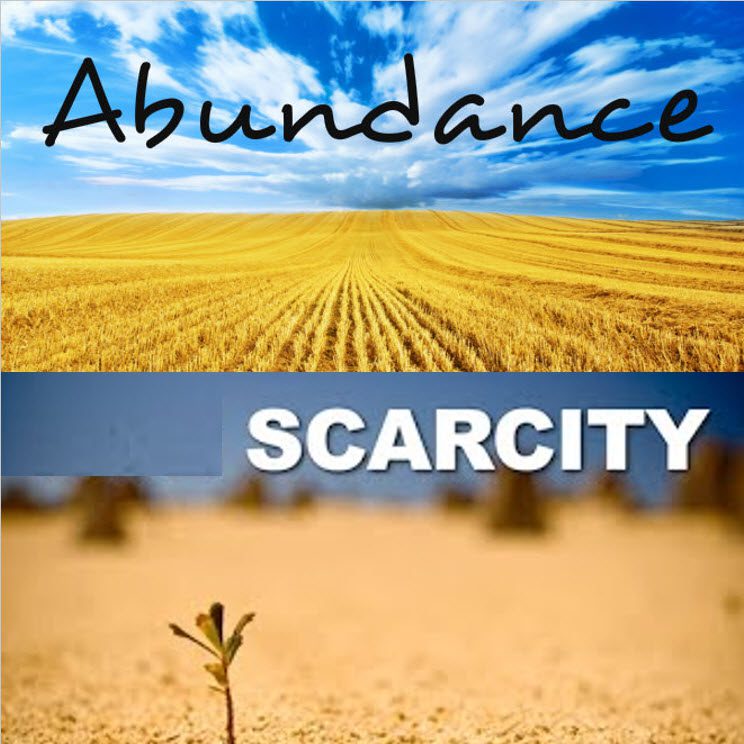
Image result for scarcity or abundance

Thinking about these things reminds me of a recent blog post by Richard Rohr1 in which he talks about the difference between what he calls the “Economy of Scarcity” which is the economic basis for virtually every nation in the world, including ours, and the “Economy of Abundance” which marks the Kingdom of GOD.  In his post, Rohr says that world economies operate on the belief that there is only so much of everything to go around.  Resources are limited, and a necessary aspect of reality is that those who gain control of the largest amounts of these scarce resources are positioned to dictate how the world operates.  This line of thinking is a perfect reflection of a perverted golden rule: “Them that has the gold rules.”

A consequence of this is that institutions (and some people) work to garner and control as much of these scarce resources as they perceive are needed to support the agendas they value. In an ideal scenario, the agenda would be to benefit the common good of all, but too often, the common good has not been the primary agenda.  A pattern in human history shows that the hoarding of resources has been paralleled by the hoarding and use of power needed to protect those resources and the ability to control them.  The overflow has been conflicts of various levels of intensity resulting at every level of human society.  Exclusivity, elitism, structures of haves and have nots, caste and class systems, and a number of isms are by-products of these concerted activities to control and distribute wealth in inequitable ways.

Image result for feeding of the 5000

Fr. Rohr points to the “Economy of Abundance” exhibited by Jesus as a rebuke of the “Economy of Scarcity.” One example he cites is the feeding of the multitudes found in Matthew 14 and Luke 9.  It’s been estimated that somewhere in the area of 12,000 to 15,000 people (the count of 5,000 refers to the men present) had been following Jesus on this occasion, and there was a need for them to eat.  Jesus instructed His disciples to feed all of these people.  They were dumbfounded and replied “We have only five loaves and two fish,” which they had gotten from a young boy.  We all know what Jesus did (or I assume you know; if not please read the account in the Bible).

If we lay aside, for a moment, the miraculous aspect, and focus on the difference between Jesus and His disciples, we see the two mental models at work. The mental model of the disciples was an “Economy of Scarcity:” “We only have…That’s all there is…There’s only so much to go around…Nothing close to meeting everyone’s need can happen here and now.” Jesus’ mental model was centered in the Kingdom of GOD, where there is never a shortage, there’s always more than enough…and that’s what was witnessed that day, for after all the people were filled there was enough left over to fill twelve baskets.  There was abundance.

Image result for rich young ruler

Another example is that of the “Rich Young Ruler” (Matthew 19) who approached Jesus one day wanting to know the path to eternal life. After some back and forth, Jesus told him to sell all his possessions, give them to the poor, and then follow Him (Jesus).  The man balked, and left dejected because he had an attachment to his material wealth that would not (1) allow him to give it to those who had little or no wealth, and (2) place his trust in the One who knows no lack and whom all of Christianity (and Judaism along with Islam) claims is the Lord of all creation.

I admit, I’m still mulling over this, wondering how much of my life has been limited by an assumption that the “scarcity” model is the only model or the right model. I think about that, but I also think about whether the “abundance” model is beyond my reach as long as I’m still earthbound, or if my faith is just too small.

Image result for prosperity theology

I need to be clear here: I am not driven by a longing for a kind of prosperity that manifests itself in gaining material abundance, particularly as a sign of GOD’s favor. I reject that as theologically and biblically unsound.  I think it’s just another way of reinforcing the “Economy of Scarcity” model where “faith” is used to seek my portion of material gain.  Jesus and His disciples were still poor men, by the world’s standards, after the feeding of “the 5,000” and the subsequent feeding of “the 4,000” (see Mark 8).

When Jesus spoke of having come to “give life and give it more abundantly” (John 10:10), He was referencing abundance in a Kingdom context where there is an abundance of mutual love and peace and freedom from all sources of internal and external domination and where no one has to go without so that someone else can have more than they need. My term for that is “Economy of Enough.” Isn’t this the heart of Matthew 6:19-34 where Jesus speaks on earthly versus heavenly treasure and the foolishness of worry?

Still, I confess I’m trying to work through this and am not settled yet. Perhaps I need more of what Paul discusses in Romans 12:1-2 (transformation of my mental models).  Perhaps I need more of the Holy Spirit power that enables GOD to do exceeding abundantly more than I ask or think…according to the power at work in us (Ephesians 3:20).

In the meantime, I’ll try to be open to new ways to give myself away. GOD is worthy of that.

  1. Rohr, Richard, “Scarcity or Abundance.” https://mail.google.com/mail/u/0/#search/richard+rohr/164692d659020060. July 5, 2018.

© Byron L. Hannon, 2018. All rights reserved for text content.

Our Ever Present Help

or, Helpless but not Hopeless

There are times when we feel abject helplessness. As much as we may fight against that thought, it’s part of the human terrain.  The causes are myriad: experiencing an unexpected loss, being confronted by tragedy, unrelenting illness, betrayal by a loved one, that hurtful surprise that can manifest itself in so many ways, and so on.  Circumstances such as these can produce a sorrow that attaches itself to our deepest inner parts, unseen but vey tangible nonetheless.

Image result for sorrow

This pain of this helplessness exposes any façade that tries to communicate that we`re in control. It unmasks ways we misunderstand and therefore misapply Paul`s pronouncement that he is able to “do all things through Him who strengthens me” (Philippians 4:13), reducing it to “I can do all things.”

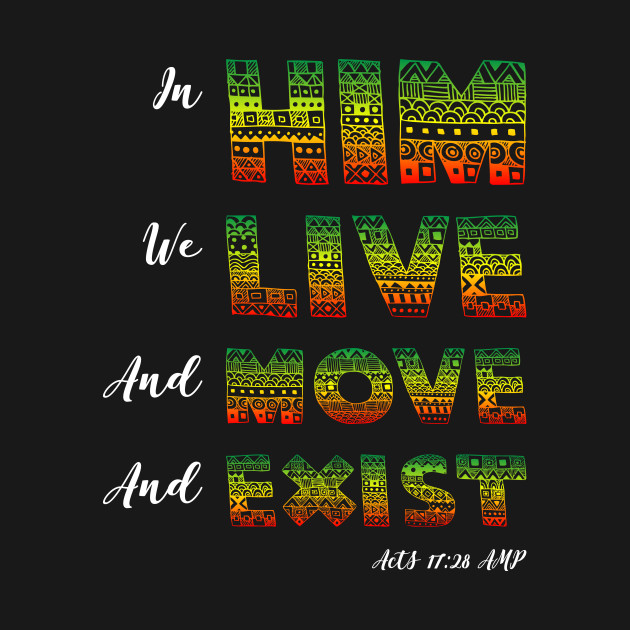
Our truth is that, in cosmic terms, we are weak, despite any pride-based protestations to the contrary. The “strength” we exert is often an expression of our ego’s desire to assert itself.  We may do well for awhile, but sooner or later, the event that reveals our helplessness reminds us that control is an illusion.  We would do well to remember that it is only “in Him we live and move and have our being” (Acts 17:28).

Image result for act 17 28

The balloon of the Apostle Paul’s own tendency for hubris was burst repeatedly by the difficulties and hard circumstances GOD allowed in his life, which ironically made his ministry so powerful for it was due to God’s grace and not Paul’s pedigree or self-defined aspirations (see 2 Corinthians 12:9-10). This was a gift, strangely wrapped, but a gift nonetheless.  Perhaps the abundant life Jesus came to give (John 10:10) is paradoxically rooted in our willingness to surrender to the reality of our weakness so that grace is given space to do what only grace can do.  This seems to be the pattern in the lives of Jesus and Paul and all those we consider people of deep faith and spiritual reserve, whether ancient or contemporary.

The sons of Korah (liturgical Temple choir of ancient Israel) sang: “GOD is our refuge and strength, an ever present help in trouble. Therefore we will not fear…” (Psalm 46:1-2).  Perhaps trusting that God’s “riches in glory” are sufficient for whatever helplessness we experience, that is, not running from or denying our weakness but offering it to Him as an acknowledgment of dependence and faith may be the pathway to the strength we need in order to overcome. Perhaps that is a gift from Him that only requires that we receive it.

Image result for god is my strength

One of my favorite psalms of David is 131:

My heart is not proud, Lord, my eyes are not haughty.                                                        I do not concern myself with great matters                                                                           or things too wonderful for me.                                                                                            But I have calmed and quieted myself.                                                                                     I am like a weaned child with it’s mother,                                                                            like A weaned child, I am content.                                                                                   Israel, put your hope in the Lord,                                                                                        Both now and forevermore.

Peace and Blessings.

© Byron L. Hannon, 2018. All rights reserved for text content.


What Good Is It?

 “For the love of money is a root of all kinds of evil. Some people, eager for money, have wandered from the faith and pierced themselves with many griefs.” – 1 Timothy 6:10

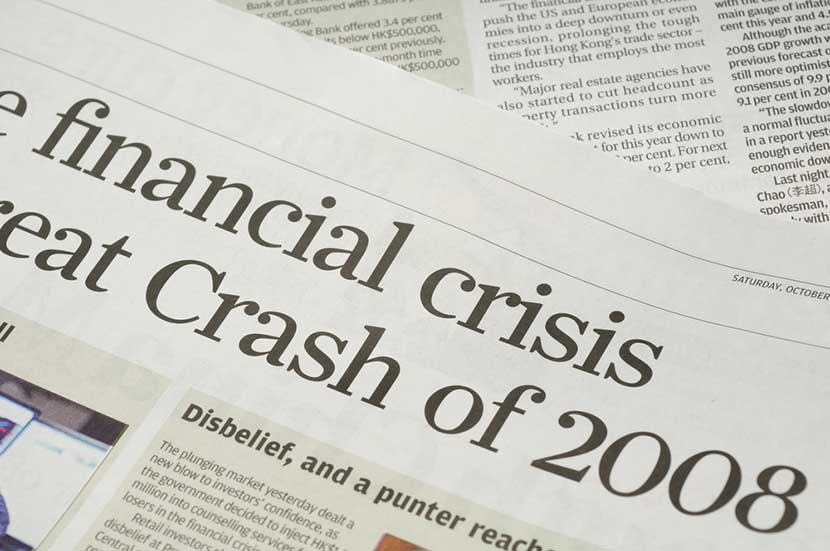
 Recently over the course of three weeks, I watched a movie, Margin Call, three times.  I’m fairly sure I’ll watch it again if I have the opportunity. Margin Call, released in 2011, is a movie that fictionalizes a series of events within a Wall Street investment bank associated with the start of the severe economic recession that hit the U.S. and the rest of the world in 2008.

Image result for financial crisis 2008

Margin Call didn’t get a lot of press when it was first released nor did it make a lot of money for its backers despite being a well-made film. It stars a number of well-known actors who most people would recognize by face, if not by name.

The movie details the discovery of a serious, fundamental error in the investment firm’s operating business model and how the leaders of this worldwide company choose to deal with the discovery. Seeking to avoid a full-blown internal financial meltdown, these leaders initiate a sequence of decisions and actions intended to minimize the negative financial impact on their company, despite the fact that these same decisions and actions will have a severe and hurtful ripple effect on many of their own employees, their competitors, other organizations, and ultimately the national and international economy.  Billions, even trillions, of dollars are in play; and the first priority of this group of people becomes evident: protect the company and protect themselves, all the while knowing that the ruinous impact of this stance would extend far beyond the sphere of their investment banking firm.

Image result for love of money

Questions of ethical conduct are cast aside so that the definition of “doing the right thing” becomes the same as their priority: self-protection. Even those who are initially resistant or hesitant because of their personal ethics, and those who are about to lose their jobs are co-opted by the lure of being “taken care” of financially if they play along, as well as the threat that their failure to play along would result in retribution.

Image result for golden handcuffs

And so the people in this movie conspire to do and then do some very disreputable things, even when they know those things to be wrong.  And they do them because of money.

Being attracted to this movie is partly based on my experience working in a large corporate company, and some of the values and behaviors I witnessed that seemed money-driven. Of course, I never witnessed anything remotely close to the actions of what Margin Call portrayed, but I easily recognized how “golden handcuffs” (using compensation provisions to make it more difficult for people to leave voluntarily) helped to keep key talent tied to the organization.

Paul, in his instruction to Timothy, talked specifically about the attitude and conduct of those who minister. He was promoting simplicity of life and contentment within that lifestyle, saying that seeking after riches was a snare that led to other difficulties and evils.  I do think there is an application here for everyone, not just those in ministerial vocations.  The same principle applies (the dangers of seeking or hungering after money).  Neither Jesus nor Paul passed judgment against having money, their judgment was against being covetous for money.

“The problem with the rich young ruler wasn’t that he had riches but rather the riches had him.” – Gary Nietzhe

When the “rich young ruler” approached Jesus and asked Him about what good thing he could do to earn eternal life (Matthew 19:16-17), Jesus redirected his understanding by telling the young man that all goodness is centered in GOD.  Internalizing and remembering this remains a challenge for us, today, because we tend to seek goodness in so many things other than GOD, including money and what money can acquire.

So many are figuratively up to their eyeballs in financial debt as a result of trying to finance “a better life with nicer things,” and now have to constantly figure out ways to manage the financial complexity they’ve created. And many can’t work it out.

  1. For many years, illegal lotteries (“the numbers”) operated in poorer communities offering a touch of hope that if “I can just hit that number,” I can ____________ (you fill in the blank).
  2. Legalized gambling through state-run lotteries, sometimes offering multi-million jackpots, has replaced the illegal numbers operations, but they sell the same gambit of getting rich.
  3. How many people have developed gambling addictions fed by legal and illegal casinos and other betting operations?
  4. How many stories have we read about children being left in cars for hours while their parent was in a casino?
  5. How many stories have we heard about corrupt medical practitioners overbilling Medicare or overcharging patients?
  6. What about people who claim an injury in order to collect workers’ compensation and then are found working another job, collecting money from both?
  7. Identity theft and robberies of all kinds are driven by one thing: a hunger for money, despite the immorality of taking, sometimes forcibly, from others.
  8. And how many politicians are dependent upon big-money lobbyists to get elected and stay elected?
  9. I’m sure I’m not the first person who questions whether Abraham Lincoln’s concept of “government of the people, by the people and for the people” has become government of, by and for those with the deepest pockets.
  10. How many “evils” can be counted just from reading what’s above…and there are so many others.


Jesus said that it is impossible to serve both GOD and mammon, meaning the desire for possessions and material gain (Matthew 6:24 and Luke 16:13).  He went on to say that only one of them will get our sincere devotion, and the other will be set aside.  This is why Paul was cautioning Timothy; there is no middle-ground position.  If GOD is the center of what is truly good, why do some people make money their good and their god?  This leads me to what I think is a logical question: What good will it be for someone to gain the whole world, yet forfeit their soul?” (Matt. 16:26; Mark 8:36).

Image result for flip the script

The actors in Margin Call were following a script that required them to be stereotypical worldly, self-centered, self-seeking, money-driven types who were willing to sell their souls because “the business always comes first.”  But we don’t have to look far to see a reality just as real and pernicious, one that purports to offer forms of “good” that are not centered in GOD.  We need to be watchful about the scripts we select for our lives.

Father, help us to see with clear eyes and hear with open ears. Help us to grasp after only that which profits our souls.  Amen.

© Byron L. Hannon. All rights reserved for text content.


Love’s In Need

Being deeply loved by someone gives you strength, while loving someone deeply gives you courage. – Lao Tzu

Love is friendship that has caught fire. It is quiet understanding, mutual confidence, sharing and forgiving.  It is loyalty through good and bad times.  It settles for less than perfection and makes allowance for human weaknesses. – Ann Landers

They do not love who do not show their love. – William Shakespeare

Darkness cannot drive out darkness; only light can do that. Hate cannot drive out hate; only love can do that. – Martin Luther King, Jr.

Love and compassion are necessities, not luxuries. Without them, humanity cannot survive. – Dalia Lama

“The most important one,” answered Jesus, “is this: ‘Hear, O Israel: The Lord our God, the Lord is one. Love the Lord your God with all your heart and with all your soul and with all your mind and with all your strength.’ The second is this: ‘Love your neighbor as yourself.’ There is no commandment greater than these.” – Mark 12:29-31

Image result for small group bible studies

Several years ago, I facilitated a group discussion on Living Biblically in Contemporary Society.  My intent was to create opportunities for dialog among a diverse group of Christians in our church on issues common in society then, and just as much today: immigration, gun control, sexual identity, climate change, race, and other topics on the societal radar.  Our discussions were lively, and by no means did everyone agree on everything, which I expected.  The underlying consideration was wrestling with how we could demonstrate a Christ-like ethos at every turn, not on reaching agreement about the rightness or wrongness of any given position.

 The core of that ethos, as I see it, is found in John 3:16, one of the most referenced passages in the Bible: For God so loved the world that He gave His one and only Son, that whoever believes in Him shall not perish but have eternal life.”  This one statement leads me to this conclusion: Those who place their faith in GOD through Jesus Christ are to love what He loved and still loves, irrespective of whether we agree with the moral appropriateness of a social position, political stance, or behavior that is an outgrowth of an issue.  Love does not equate to condoning everything that happens around us.  If it did, any and all moral stances rooted in a desire to obey the GOD of the Bible would be meaningless.                                

Image result for library of congress 

I suspect that it would take the Library of Congress (or perhaps more) to house all of the quotes from notable people about our need for giving and receiving giving love. The kind of love the Apostle Paul speaks of in 1 Corinthians 13 comes immediately to my mind because of John 3:16, but not to the exclusion of romantic love or love of family members and friends.  Paul’s description is special because it is all-encompassing and without condition, which makes it also rare.  I view it as a key mile marker in “the race to win the prize for which GOD has called me heavenward in Christ Jesus” that Paul speaks of Philippians 3:14.

Image result for 1 Cor 13

 To recap, here’s what Paul says this kind of love does and doesn’t do:

  • It has a lot of patience and puts up with an awful lot
  • It is kind
  • It is not driven by ego
  • It doesn’t act out
  • It is not self-seeking
  • It is hard to provoke
  • It thinks the best of others, not the worst
  • It takes no joy in wrongdoing
  • It finds the truth to be a source of joy
  • In the face of problems caused by others, it is never cynical
  • It is always hopeful even when confronted with difficulty

 Whenever I read the passage, I’m reminded that this is the love that GOD has for me, revealed in the life, death and resurrection of His Son, Jesus. I’m also reminded that I’m called to have the same goal as the Apostle Paul, including loving GOD and my neighbor in this way, which is only possible through the ministry of GOD’s Holy Spirit working in me.  If you’re unclear as to whom your neighbor is, review Luke 10:25-37 (Hint: GOD’s definition is pretty broad).

Because I live in the 21st century rather than the 1st, my natural tendency is to think that the possibility of loving like this is a distinctly and ridiculously naïve notion, i.e. it is impossible to give or to receive love this way because of the climate of competition between tribes, boundary protection (personal and group), the hoarding of resources for the sake of having a sense of security, and the gaining of power and influence (or, at least, aligning ourselves to the powerful and influential).

A friend once said our social climate today is really no different than what we see in street gang behavior, with each gang having its membership requirements, territories, identifiers, code words and signs. Although it seems to be increasingly amplified today, I think human history, since Adam’s sin in Eden, reveals that it has been this way since Cain’s jealousy of and subsequent destruction of Abel.  If humanity has always been this way and continues to be this way, then the Lord’s admonition to love is the only counter force that can demonstrate another way…you might say The Way.  Ironically, this is what Christianity was called before it was called Christianity.

Image result for the way


This issue has been percolating in me for several months, prompted by a fresh hearing of Stevie Wonder’s, “Love’s In Need of Love Today.”  Recorded in 1974 as one entry on his masterful Songs in the Key of Life double album, it speaks in a soul touching way, of the very serious, negative impacts on all of life occurring because of serious deficits of love.  Stevie asks us to consider that love itself feels unloved, the very thing that some of the greatest thinkers in history, including the Greatest, say is essential to our being.  Love feels unloved! How messed-up is that?

To choose not to love is downward devolution from what humanity is supposed to be. To choose not to love is to deny the need for godliness. To reject love by not loving is to reject GOD Himself, for He is love (1 John 4:8).  This is not Hallmark sentimentality; this is the Word of GOD in all of its weight and glory.

If, as Stevie Wonder sings, love is need of love today, perhaps we who carry the name “Christian” need to submit ourselves to the examination light of GOD’s Word and Spirit, and the example of His only begotten Son.  We need to make sure that we are not in the way of what He wants to accomplish in us and through us, but in The Way.

© Byron L. Hannon, 2018. All rights reserved for textual content.


If you’ve never heard Stevie’s song before, here’s a clip:

https://www.google.com/search?q=love%27s+in+need+of+love+today&source=lnms&sa=X&ved=0ahUKEwiY1ZaB5qTcAhWmiOAKHYWlDYMQ_AUICSgA&biw=1051&bih=461&dpr=1.3


Inaugural Post

Image result for bear much fruit

“I am the vine; you are the branches. If you remain in me and I in you, you will bear much fruit; apart from me you can do nothing.” – John 15:5

For my inaugural post for Just 1 Voice, I chose a passage that’s been the focus of my meditation for at least two years: the inescapable reality that Jesus Christ is the source of all life and all that should result from living.  Boiled down, this is the same message proclaimed by John the Baptist over two millennia ago, whom the prophet Isaiah called, “the voice of one crying out in the wilderness” (40:3).

What is striking is that so many in the West still experience a wilderness in their souls despite the advancement of human reason, the progress of science and technology, political freedom, easy access to education and various sources of knowledge, material affluence, and the wide availability of all sorts of pleasures unknown or unavailable in John’s time. I’ve met and talked with too many people, inside and outside the church, over the years to know that these things are not enough to create the oasis they seek.  I’ve seen their struggles, heard their hurts, disappointments, anger, and lingering questions.  On occasion, I’ve even been on the receiving end of their anger that masked a resentment not necessarily aimed at me or a fear they couldn’t otherwise express.  Much of the objective data widely available tells us a similar story.  Many, many people are searching for something seemingly beyond their grasp.

I’m speaking to this because I feel compelled to speak to it, albeit, I’m just one voice, one among many. I suppose that’s the preacher in me.  Some voices are saying similar things; others are vehement in saying much the opposite.  When has it ever been different?  It hasn’t.  And so, in the days ahead, I will be adding my one voice to an already crowded landscape because I not only believe in Jesus, that is, Jesus as a living reality, I also believe what He said.  I want to bear good fruit; and if I can encourage just one person to see Jesus in a light that helps them bear good fruit, then I’m going to let the ink flow.

Here’s a final thought. This is a quote from Charles Spurgeon, the great 19th century preacher and evangelist: “Unbelief is an evil thing in itself…Think how you would feel if others disbelieved you.”

“Behold, the Lamb of God who takes away the sin of the world!”


(John the Baptist in John 1:29)


© Byron L. Hannon, 2018. All rights reserved for textual content.